In recent years, there has been a greater recognition that success of
conservation efforts as well as overall economic well-being depend on
ecological and environmental factors that are largely shaped by human
influence and that the human factor should be taken into consideration
if conservation is to be effective (Folke 2006; Sarukhán 2006). With
funding for conservation ever more competitive while environmental
issues requiring conservation efforts are ever more numerous, the need
to have an interdisciplinary approach to conservation, one that draws
from beyond just the biological sciences, has never been greater. With
this in mind, I have approached the problem of bird and habitat
conservation from a human dimensions perspective. My research involves
3 key components: economics, education, and environmental sociology.
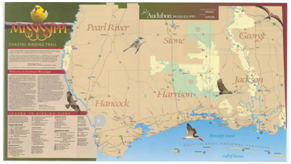
ECONOMICS: Building the Better Birding Trail: Birdwatching Ecotourism and the Mississippi Coastal Birding Trail
A primary goal of ecotourism is to integrate economic well-being with
sustainable use, and therefore conservation of, natural resources.
According to this model of conservation, communities must benefit
economically for conservation to take place. Sarukhán (2006) illustrates
this relationship:
“ There will be little hope for conservation and sustainable
management if owners of ecosystems have no economic incentives (and
therefore alternatives) but to cut down forest or convert their
ecosystems into other kinds of productive systems, even if production is
short term.”
It is with this proposed relationship in mind that this project examines:
1) the economic impact of birdwatching along the Mississippi and Alabama
coasts and 2) the recreational preferences of birdwatchers as they relate
to economic development variables. These data will be used to support the
use of ecotourism as a local economic development tool in coastal Mississippi
and to make informed decisions on the restructuring of the Mississippi
Coastal Birding Trail so that it is sustainable, and more effective at
conservation and at positively impacting local economies.
EDUCATION: The Educational Impact of a Birdwatching Citizen Science Program Implemented in Schools
Conservation education starts with a basic appreciation of nature. Recent
popular (Louv 2005) and scientific (Pergams and Zaradic 2006, 2008) literature
have suggested that a disconnect exists between humans, especially children,
and nature. A recurring theme in this literature is that direct involvement
in nature is being replaced by technology and other diversions. As children
do make decisions about how to involve themselves in the natural world and
positive childhood experiences can influence an individual's attitudes towards
nature as an adult (e.g. Thompson et al. 2008), it is important to understand
what factors may influence their decision making.
The Great Backyard Bird Count (GBBC) is a citizen science program run jointly
by the National Audubon Society and the Cornell Lab of Ornithology. This annual
four-day event engages bird watchers of all ages in counting birds to create a
real-time snapshot of where the birds are across the continent. The Pascagoula
River Audubon Center (PRAC) in Moss Point, MS has been conducting the GBBC with
schools in coastal MS for several years. However, no prior assessment of the
GBBC or the in-class educational component has been conducted. This study will
assess the impact of the program on its student participants and will evaluate
what factors influence participation. The results of this study will be used to
refine the educational approach to the GBBC program and will shed light on
student involvement in science and in nature.
SOCIOBIOLOGY: The Environmental and Ecological Beliefs and Behaviors Of Adult Birdwatchers
Birdwatchers are dependent on natural resources to conduct their recreational
activity and as such, are proposed to demonstrate a level of awareness of and
concern for those resources commensurate with level of involvement. Previous
research on other nature-based recreationists, however, has shown that individual
meaning associated with an activity can serve to mediate this relationship
(Bright and Porter 2001). Given that birdwatchers do not compose one homogeneous
population (e.g. Cole and Scott 1999), I predict that individual meaning attached
to the activity will partially or fully mediate the relationship. Further, given
the differences among birdwatchers, it is hypothesized that there is a
relationship between birdwatchers' 1) level of involvement, 2) expertise,
and 3) motivation, and their knowledge of factors that influence bird populations
and their conservation.
An understanding of birdwatchers' environmental views and knowledge of bird
conservation issues is necessary to develop effective education on issues pertaining
to conservation of natural resources geared towards this increasing population of
recreationists.