School of Health Professions
About the USM PA Program
Page Content
Program Mission
The mission of the University of Southern Mississippi (USM) Physician Assistant (PA) program is to educate and mentor students to provide evidence-based, collaborative, patient-centered medical care. With an emphasis on rural and medically underserved areas, our graduates will be prepared to provide compassionate medical care to all people and populations.
Program Vision
The USM PA program’s evidence-based curriculum will promote the development of ethical, clinically knowledgeable practitioners prepared to serve the diverse populations in Mississippi and throughout the country. Our graduates will be prepared to function in primary care and specialty care in both rural and urban settings and will promote and participate in transformation of the healthcare system to a model that provides compassionate and culturally responsive care for all.
Program Goals
- Outcome measure 1: matriculated student data
Benchmarks:
-
-
- Average matriculated cohort undergraduate GPA at or above 3.30 (4.00 scale).
- Average matriculated cohort greater than 500 health care hours (including shadowing).
-
- Outcome measure 2: program graduation and attrition rates
Benchmark:
-
-
- For each cohort, 94% or higher graduation rate (< 6% student attrition)
-
- Outcome measure 1a: summative evaluation data
Benchmark:
-
-
- PAEA End of CurriculumTM exam – cohort average at or above 90% first-time pass rate, and 100% final pass rate
-
- Outcome measure 1b: PANCE pass rate
Benchmark:
-
-
- PANCE pass rate for each cohort at or above 90% for first-time takers
-
- Outcome measure 2a: student perceptions (Student Graduate Exit Survey)
Benchmark:
-
-
- Greater than or equal to 3.5 (5-point Likert scale) cohort aggregate average indicating students perceive that the program has prepared them for entering clinical practice
-
- Outcome measure 2b: student perceptions (Student Graduate Exit Survey)
Benchmark:
-
-
- Greater than or equal to 3.5 (5-point Likert scale) cohort aggregate average indicating students perceive that the program has prepared them to provide evidence-based medical care
-
- Outcome measure 3a: preceptor perceptions (Preceptor Survey of Student Preparedness)
Benchmark:
-
-
- Greater than or equal to 3.5 (5-point Likert scale) respondent aggregate average indicating preceptors perceive that the students’ education prepares them for entering clinical practice
-
- Outcome measure 3b: preceptor perceptions (Preceptor Survey of Student Preparedness)
Benchmark:
-
-
- Greater than or equal to 3.5 (5-point Likert scale) respondent aggregate average indicating preceptors perceive that the students’ education prepares them to provide evidence-based medical care
-
- Outcome measure 4a: faculty perceptions (Annual Faculty & Staff Survey)
Benchmark:
-
-
- Greater than or equal to 3.5 (5-point Likert scale) respondent aggregate average indicating faculty perceive that the program prepares students for entering clinical practice
-
- Outcome measure 4b: faculty perceptions (Annual Faculty & Staff Survey)
Benchmark:
-
-
- Greater than or equal to 3.5 (5-point Likert scale) respondent aggregate average indicating faculty perceive that the program prepares students to provide evidence-based medical care
-
- Outcome measure 1a: student perceptions (Student Graduate Exit Survey)
Benchmark:
-
-
- Greater than or equal to 3.5 (5-point Likert scale) cohort aggregate average indicating students perceive that the program has prepared them to provide compassionate care
-
- Outcome measure 1b: student perceptions (Student Graduate Exit Survey)
Benchmark:
-
-
- Greater than or equal to 3.5 (5-point Likert scale) cohort aggregate average indicating students perceive that the program has prepared them to provide collaborative care
-
- Outcome measure 1c: student perceptions (Student Graduate Exit Survey)
Benchmark:
-
-
- Greater than or equal to 3.5 (5-point Likert scale) cohort aggregate average indicating students perceive that the program has prepared them to function on an interprofessional team
-
- Outcome measure 2a: preceptor perceptions (Preceptor Survey of Student Preparedness)
Benchmark:
-
-
- Greater than or equal to 3.5 (5-point Likert scale) respondent aggregate average indicating preceptors perceive that the students’ education prepares them to provide compassionate care
-
- Outcome measure 2b: preceptor perceptions (Preceptor Survey of Student Preparedness)
Benchmark:
-
-
- Greater than or equal to 3.5 (5-point Likert scale) respondent aggregate average indicating preceptors perceive that the students’ education prepares them to provide collaborative care
-
- Outcome measure 2c: preceptor perceptions (Preceptor Survey of Student Preparedness)
Benchmark:
-
-
- Greater than or equal to 3.5 (5-point Likert scale) respondent aggregate average indicating preceptors perceive that the students’ education prepares them to provide to function on an interprofessional team
-
- Outcome measure 3a: faculty perceptions (Annual Faculty & Staff Survey)
Benchmark:
-
-
- Greater than or equal to 3.5 (5-point Likert scale) respondent aggregate average indicating faculty perceive that the program prepares students to provide compassionate care
-
- Outcome measure 3b: faculty perceptions (Annual Faculty & Staff Survey)
Benchmark:
-
-
- Greater than or equal to 3.5 (5-point Likert scale) respondent aggregate average indicating faculty perceive that the program prepares students to provide collaborative care
-
- Outcome measure 3c: faculty perceptions (Annual Faculty & Staff Survey)
Benchmark:
-
-
- Greater than or equal to 3.5 (5-point Likert scale) respondent aggregate average indicating faculty perceive that the program prepares students to function on an interprofessional team
-
- Outcome measure 1a: student perceptions (Student Graduate Exit Survey)
Benchmark:
-
-
- Greater than or equal to 3.5 (5-point Likert scale) cohort aggregate average indicating students perceive that the program (learning environment) has prepared them to provide culturally-competent care
-
- Outcome measure 1b: student perceptions (Student Graduate Exit Survey)
Benchmark:
-
-
- Greater than or equal to 3.5 (5-point Likert scale) cohort aggregate average indicating students perceive that the program (learning environment) has prepared them to serve the needs of various populations
-
- Outcome measure 2a: preceptor perceptions (Preceptor Survey of Student Preparedness)
Benchmark:
-
-
- Greater than or equal to 3.5 (5-point Likert scale) respondent aggregate average indicating that the students’ education (learning environment) prepares them to provide culturally-competent care.
-
- Outcome measure 2b: preceptor perceptions (Preceptor Survey of Student Preparedness)
Benchmark:
-
-
- Greater than or equal to 3.5 (5-point Likert scale) respondent aggregate average indicating that the students’ education (learning environment) prepares them to serve the needs of various populations
-
- Outcome measure 3a: faculty perceptions (Annual Faculty & Staff Survey)
Benchmark:
-
-
- Greater than or equal to 3.5 (5-point Likert scale) respondent aggregate average indicating faculty perceive that the program (learning environment) prepares students to provide culturally-competent care
-
- Outcome measure 3b: faculty perceptions (Annual Faculty & Staff Survey)
Benchmark:
-
-
- Greater than or equal to 3.5 (5-point Likert scale) respondent aggregate average indicating faculty perceive that the program (learning environment) prepares students to serve the needs of various populations
-
- Outcome measure 4: student clinical placements
Benchmark:
-
-
- All students will have 25% or more of their Supervised Clinical Practice Experience (SCPE) placements in rural or medically underserved communities
-
The effectiveness of the USM PA program in meeting its goals will be published after graduation of the inaugural class in 2029.
The USM Physician Assistant program will publish the annual NCCPA PANCE Exam Performance Summary Report Last 5 Years provided by the NCCPA after the first cohort graduates in 2029 and all graduates complete their certification examinations, but no later than April 1, 2030.
The USM Physician Assistant program will publish its attrition and graduation information after the first cohort graduates in 2029.
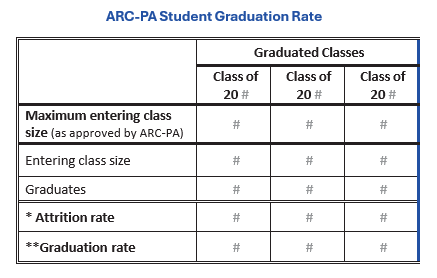
Attrition rate calculation: Number of students who attritted from cohort (decelerated + withdrawals + dismissals) divided by the (entering class size + number joining class cohort).
Graduation rate calculation: Number of cohort graduates divided by the (entering class size + number joining class cohort).