MPI Leads Hydrogen Fuel Technology Evaluation at Southern Miss
Thu, 05/21/2026 - 12:58am | By: David Tisdale

The Mississippi Polymer Institute (MPI) at The University of Southern Mississippi is steering evaluation of the commercial and industrial viability of clean energy technology, including hydrogen’s potential to efficiently power automobiles.
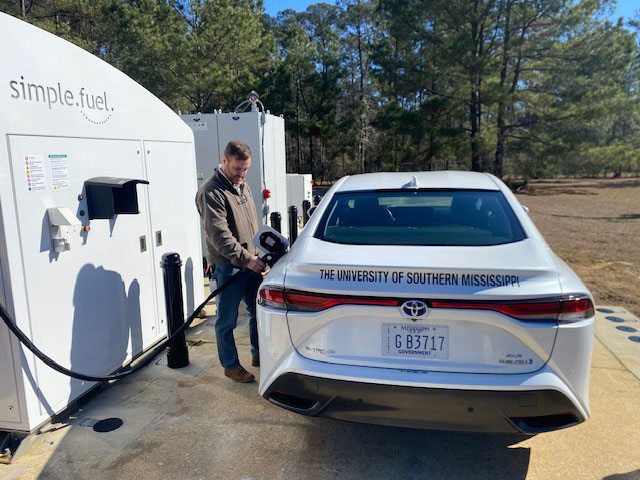
With support from federal funding through the National Institute of Standards and Technology (NIST), MPI is assessing the potential uses of hydrogen power through an on-site hydrogen fueling station and a hydrogen-powered car. Titled “Advanced Clean Energy Materials Validation and Product Demonstration,” the project is now in the monitoring phase as hydrogen is being generated and used.
MPI Director Dr. Monica Tisack, who spearheaded the initiative, has been familiar with fuel cell cars for many years. But it was while she was with an economic development group in Antwerp a few years ago that she became impressed with the use of the technology for ships, truck transportation and tractors.
“While I really wanted to demonstrate the use of tractors with the technology, none are yet available in the U.S.,” Tisack said of her early consideration of pursuing the project. “But fuel cell cars are available, so this option still provides a great opportunity to demonstrate and evaluate the pros and cons to the community and interested businesses.”
MPI Chief Scientist Dr. Samuel Lahasky said it has long been known that hydrogen can be used as a fuel source, and that many technological advances have contributed to a resurgence in its use as an alternative fuel. Most notable among these advances is the advent of the proton exchange membrane (PEM) fuel cell.
Lahasky’s role is as project leader, educator and point person for continuing maintenance. Along with Tisack and Lahasky, other MPI team members involved with the project include Cameron Nuzzo, who serves as operations manager for the Accelerator and Innovation and Commercialization Park and is charged with hydrogen fueling station construction and maintenance; and Michael McCullum, project manager and workforce training lead, who managed the hydrogen fueling station construction.
“Hydrogen has an energy density roughly three times that of traditional gasoline, making it an appealing alternative to fossil fuel,” Lahasky explained. “This technology is essential for an efficient conversion of hydrogen fuel into an electric current, powering motors, generators and any moving part.”
“The most important part of hydrogen’s production and use as a fuel can be traced back to the proton-exchange membrane, or PEM,” Lahasky continued. “Within the PEM, a unique polymeric material serves as a critical part of the efficiency of the fuel cell itself.”
“The polymers used within the PEM allow protons, and only protons, to pass through (i.e., a membrane that exchanges protons),” Lahasky said. “This unique characteristic allows electrons to flow through a controlled system, thus creating electricity and powering your car’s motor. Demonstrating the use of the PEM in a commercial or industrial setting is aimed at lowering the barrier for adoption for public organizations and Mississippi manufacturers.”
Inside the PEM fuel cell, hydrogen reacts with oxygen to form water. This reaction results in the movement of electrons, creating roughly 1.23 volts of electricity, at least in theory, Lahasky said.
“So, the motor of our Toyota Mirai is powered by electricity generated with a hydrogen PEM fuel cell,” he continued. “But how do we get this hydrogen? The good news here is that a PEM fuel cell can essentially also work in reverse.”
The fueling station installed at the MPI headquarters uses electricity to separate water into its molecular components — hydrogen and oxygen. This process, known as electrolysis, allows the MPI evaluation team to create hydrogen on-site in a safe and controlled manner. The fueling station, engineered by PDC Machines, can generate approximately five to 10 kilograms of H2 per day, enough fuel for roughly two to three cars, depending on a vehicle’s tank size.
MPI is one of the first locations to have a hydrogen fueling station in the Southeastern U.S. Lahasky is hopeful that other stations in nearby states come online soon, making the use of hydrogen-fueled automobiles more accessible throughout the region.
“Projects like this show exactly where Southern Miss can make a difference for the economy,” said Dr. Kelly Lucas, Southern Miss vice president for research. “By combining our strength in polymer science with real-world demonstration, the Mississippi Polymer Institute is helping industry move beyond theory and see how emerging energy technologies actually perform in practice.”
“Whether hydrogen ultimately powers vehicles, industrial systems or future manufacturing processes, the value of this work is giving businesses the data and confidence they need to evaluate new energy options. That kind of applied research is how universities help accelerate innovation and economic growth in our state,” Lucas added.
Lahasky said the project is in keeping with MPI’s roughly three decades of service to Mississippi manufacturers, entrepreneurs and industry markets.
“As a whole, we assess the efficiency, cost, environmental impact, and ease of implementation for each technology we intend to demonstrate.”
After nearly a year of planning, construction and gathering materials, MPI is currently evaluating the cost of hydrogen production, tailpipe calculations on the vehicle, and maintenance costs for both the station and the car.
“With this information, we can help Mississippi companies and residents make informed decisions on adopting clean energy alternatives,” Lahasky said.
Tisack and Lahasky said desired outcomes for the project include the ability to demonstrate and educate public and commercial organizations about the usefulness of the technology.
“Understanding how this technology can be appropriately implemented will help public organizations make informed decisions on the use of hydrogen as a fuel source,” Lahasky explained.
And while the main focus is to educate Mississippi manufacturers and industrial leaders about the benefits of hydrogen as a fuel source, MPI is also working with educators to help bring this concept into tangible classroom exercises. The latter effort includes collaboration with Southern Miss faculty members Dr. Hugh Broome and Dr. Douglas Masterson from the chemistry program, working with undergraduate students in the Scholarships Targeting Academically Rising Science, Technology, Engineering and Mathematics Students (STARSS) program. Other outreach supporting STEM education includes a recent demonstration of the technology to local students through the Area Development Partnership’s (ADP) Jumpstart-to-Success program.
“Dr. Masterson and I are excited to partner with MPI,” Broome said. “This collaboration will give STARSS scholarship recipients direct access to authentic, real-world problem-solving experiences at the intersection of science, engineering and sustainability, allowing students to apply their classroom knowledge to meaningful innovation.
“Through hands-on engagement with MPI’s NIST grant opportunity, STARSS students will strengthen the very competencies our integrated STEM education model is designed to build: mathematical reasoning, scientific application, interdisciplinary collaboration and critical thinking. This partnership represents a powerful opportunity to connect academic classroom learning with cutting-edge industry research, helping STARSS scholars see themselves as emerging STEM professionals.”
With the progress made to date on the project, Tisack said Southern Miss has the potential to be a serious player in fuel cell technology in the Southeast, building on the STEM knowledge that goes into the technology, with MPI providing practical and commercial demonstration and guidance.
“While we are the first now, we look forward to other first adopters taking action to create a fuel cell/hydrogen corridor for wider adoption and accomplishment,” Tisack continued. “Showing people what is possible aligns perfectly with our mission to assist the growth of technology-based businesses in the state.”
About the Mississippi Polymer Institute
MPI is a non-profit industrial outreach arm of The University of Southern Mississippi
that serves to foster technically-oriented business and job growth by providing technical
services. MPI serves companies, startups, inventors, economic development agencies,
schools and communities through product development, product testing, manufacturing
troubleshooting, third-party evaluations, training, sustainability assessments and
outreach.