Financial Aid
FSA Updates
Page Content
Federal Student Aid Changes from the One Big Beautiful Bill Act
One Big Beautiful Bill Act Web Center
Changes by Federal Aid Programs
No change.
Earlier versions of the bill proposed changing the definition of full-time enrollment for Pell eligibility, as well as eliminating Pell eligibility for less-than-half-time enrollment. These provisions were not included in the final legislation.
Effective: July 1, 2026, starting with award year 2026-27
Requires that foreign income be included in the AGI used to calculate Pell Grant eligibility.
Ends the current requirement that a financial aid administrator must individually determine if adding the exempted foreign income to the AGI would make the student ineligible to receive the maximum Pell Grant.
Effective: July 1, 2026
Students who receive grants or scholarships from non-federal sources covering their entire cost of attendance (COA) are ineligible to receive a Pell Grant, even if otherwise eligible for the program.
For more information see: Ineligibility for Federal Pell Grants Due to Receipt of
Non-Federal Financial Assistance
Effective: July 1, 2026
Prevents students from receiving Pell Grants if their SAI exceeds twice the maximum Pell Grant award.
No change.
An earlier version of the bill proposed eliminating the subsidized loan programs. This provision was not included in the final legislation.
Starting with the 2026-27 award year
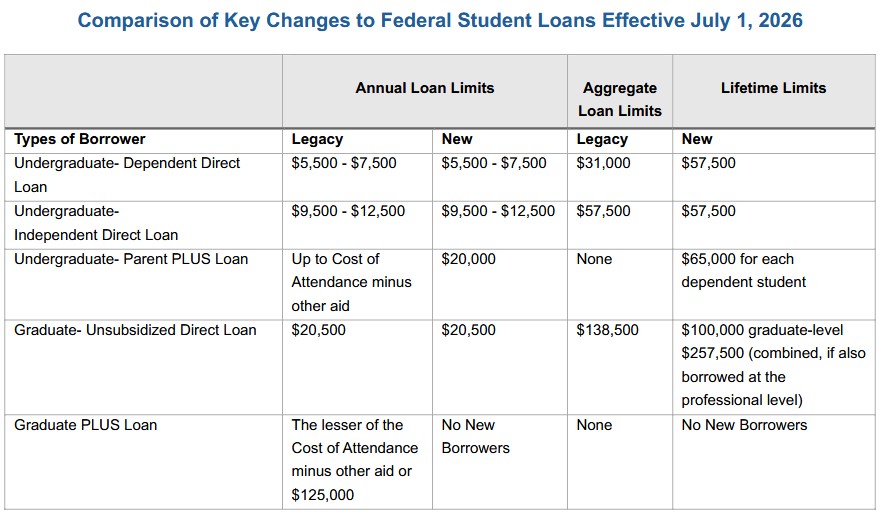
Requires institutions to prorate annual loan amounts in direct proportion to the percent of full-time status the student is enrolled.
Semester loan amounts will be based on enrolled hrs. Changes in enrollment may result in reductions in loan award amounts in current or future semesters.
Parent PLUS loans are not subject to these adjustments.
Effective: July 1, 2026
Eliminates the Graduate Plus Loan Program.
Limited Exception/Legacy Provision: Students can continue to borrow under the Graduate PLUS program (for up to three
academic years or the remainder of their expected time to credential, whichever is
less) if they remain continuously enrolled in the same program of study at the same
institution as they were enrolled as of June 30, 2026 and for whom a Direct Loan was
made
for that program of study prior to July 1, 2026.
For more information see: What Graduate Students Need to Know
Effective: July 1, 2026
Caps the annual loan limits at $20,500 for graduate students and $50,000 for professional students.
The aggregate limit is capped at $100,000 for graduate students and $200,000 for professional students, and does not include amounts borrowed as an undergraduate.
Limited Exception/Legacy Provision: Students are not subject to the new loan limits (for up to three academic years or the remainder of their expected time to credential, whichever is less) if they remain continuously enrolled in the same program of study at the same institution as they were enrolled as of June 30, 2026 and for whom a Direct Loan was made for that program of study prior to July 1, 2026.
Effective: July 1, 2026
All parents (combined) may borrow $20,000 per year per dependent student and a $65,000 aggregate limit per dependent student (without regard to amounts forgiven, repaid, or discharged).
Limited Exception: Parents are not subject to the new PLUS loan limits (for up to three academic years or the remainder of the student's expected time to credential, whichever is less) if the student remains continuously enrolled in the same program of study at the same institution as they were enrolled as of June 30, 2026 and either the parent had a Parent PLUS Loan disbursed for that same program before July 1, 2026, or the student had a Direct Loan (subsidized or unsubsidized) disbursed for that same program before July 1, 2026.
Effective: July 1, 2026
New lifetime federal loan limit of $257,500 for all Federal Direct student loans (excluding Graduate or Parent PLUS loans) borrowed for all levels of study.
Limited Exception: Students are not subject to the new lifetime loan limit (for up to three academic years or the remainder of their expected time to credential, whichever is less) if they remain continuously enrolled in the same program of study at the same institution as they were enrolled as of June 30, 2026 and they had a Direct Loan disbursed for that same program before July 1, 2026.
Changes to Student Loan Repayment
Effective: July 1, 2026
Creation of new income-driven repayment plan called the Repayment Assistance Plan (RAP).
Monthly payment is 1-10% of income based on AGI. $10 minimum monthly payment. $50 off monthly payment (base payment) per dependent. If married filing separately, spouse’s AGI and number of dependents are not included in the payment calculation. 30-year repayment period. Eliminates negative amortization. No cap on monthly payment. If a borrower makes an on-time payment that reduces their principal by less than $50, ED will make a payment to the principal, up to the amount paid, minus what was applied to the principal or $50, whichever is less.
Effective: July 1, 2026
Creation of a new standard repayment plan.
Fixed monthly payments over 10, 15, 20, or 25 years based on total loan balance.
Effective: July 1, 2026
Borrowers with new loans made on or after July 1, 2026 can be repaid using only two plans: the new tiered standard repayment plan and the new income-based repayment plan, RAP. All new Parent PLUS loans from July 1, 2026 on must be repaid under the new tiered standard repayment plan, as these loans are not eligible for RAP.
All loans must be paid under the same repayment plan, so borrowers with loans made before July 1, 2026, who take out additional loans on or after July 1, 2026, will only have RAP and the new tiered standard repayment plan as options.
Effective: July 1, 2026
Current borrowers with no new loans made on or after July 1, 2026, are eligible to enroll in the current Standard, Graduated, Extended, or Income-Based Repayment (IBR) plan, and may also opt in to the new RAP. Current borrowers may also switch between, enter, or remain on existing Income-Contingent Repayment (ICR) plans until July 1, 2028.
Borrowers who must consolidate in order to access IBR or ICR plans must have their
consolidation loan disbursed no later than June 30, 2026, as a consolidation loan
is considered a new loan and borrowers with loans on or after July 1, 2026 only have
RAP and the new tiered standard plan available to them. After June 30, 2026, consolidated
loans repaying Parent PLUS Loans would only
have the new tiered standard plan available.
.
Effective: July 1, 2028
Existing income-contingent repayment plans (ICR, PAYE, SAVE) will be eliminated July 1, 2028.
Current borrowers enrolled in ICR, PAYE, or SAVE plans must transition to an eligible repayment plan by July 1, 2028. If no selection is made by that date, they will be moved into RAP. Direct Consolidation Loans that included Parent PLUS Loans are ineligible for RAP, so these borrowers will be moved to IBR if they are enrolled in ICR prior to July 1, 2028.
Effective: July 4, 2025
Removes the requirement for borrowers to demonstrate a partial financial hardship in order to enroll in IBR.
Effective: July 1, 2027
Borrowers can rehabilitate a defaulted loan twice, instead of once as currently allowed. The minimum rehab payment for Direct Loans changes to $10.
Effective: July 1, 2027
Sunsets the economic hardship and unemployment deferments.
Borrowers with loans made before July 1, 2027, are still able to use these deferment options for those loans under the current rules.
Effective: July 1, 2027
Loans made on or after July 1, 2027, are eligible for forbearance for up to nine months in any two-year period.
Current rules allow for a forbearance up to 12 months at a time, with a cumulative limit of three years.