The University of Southern Mississippi Mourns the Loss of Dr. Gordon Cannon
Mon, 05/04/2026 - 11:33am | By: Leila J. Hamdan, Ph.D.
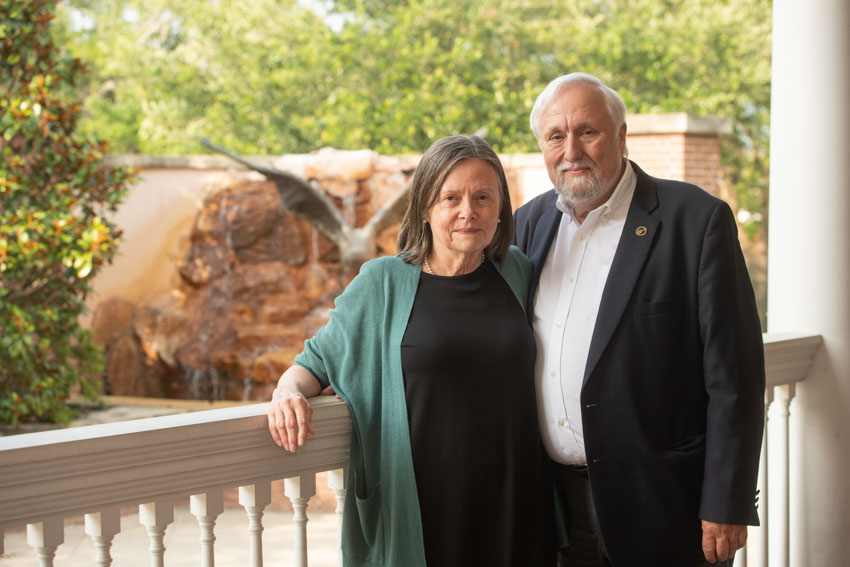
Heinhorst and Cannon
The University of Southern Mississippi community is saddened by the passing of Dr. Gordon Cannon, professor emeritus and vice president emeritus for research. Cannon passed away Friday, April 24, 2026. He retired in 2023 and his nearly 40 years of service laid the foundation that will uphold the university’s research enterprises for decades into the future.
Cannon came to Southern Miss in 1987 as an assistant professor after completing a postdoctoral fellowship at the Roche Institute of Molecular Biology. He earned his doctorate in biochemistry in 1982, and Bachelor of Science in microbiology in 1975, both from Clemson University.
He built a successful career as a member of the faculty, shaping scientific discovery through novel pathways of carbon fixation in bacteria. Throughout his career, he published more than 70 peer-reviewed publications and delivered hundreds of presentations at national and international conferences. In recognition of his exceptional scholarly accomplishments, Cannon was named a T. W. Bennett Distinguished Professor in Science and received the Southern Miss Lifetime Achievement Award from the University Research Council.
In a research paper authored by one of his collaborators, a novel species of carbon fixing bacteria, Thiomicrorhabdus cannonii, was named for him – a tribute he shared with his wife, and partner in life, science, and service, Dr. Sabine Heinhorst, professor emerita and former dean of the Southern Miss Honors College (Thiomicrorhabdus heinhorstiae). Having a species named in one’s honor is a highly significant accolade in the sciences, owing to substantial scholarly contributions. This shared honor is emblematic of how Cannon prioritized collaboration to advance discovery, and the importance of building lifelong connections through research.
Dr. Christopher Winstead, dean of the College of Arts and Sciences, remarked, “Cannon was among the most respected scientists in the field of biochemistry. He made deep and lasting contributions to his discipline, while investing in others as a mentor, colleague and friend. Many, myself included, benefited directly from his guidance and support. Those who knew him will remember not only his accomplishments, but his humor and immense generosity.”
During his academic career, he mentored six postdoctoral scholars and 18 graduate students, including 12 doctoral recipients. His impact on undergraduates was profound, with more than 40 students engaged in experiential learning in his research laboratory. He mentored students, staff, and faculty in a way that instilled purpose, inquiry, integrity and a desire to grow as professionals and people.
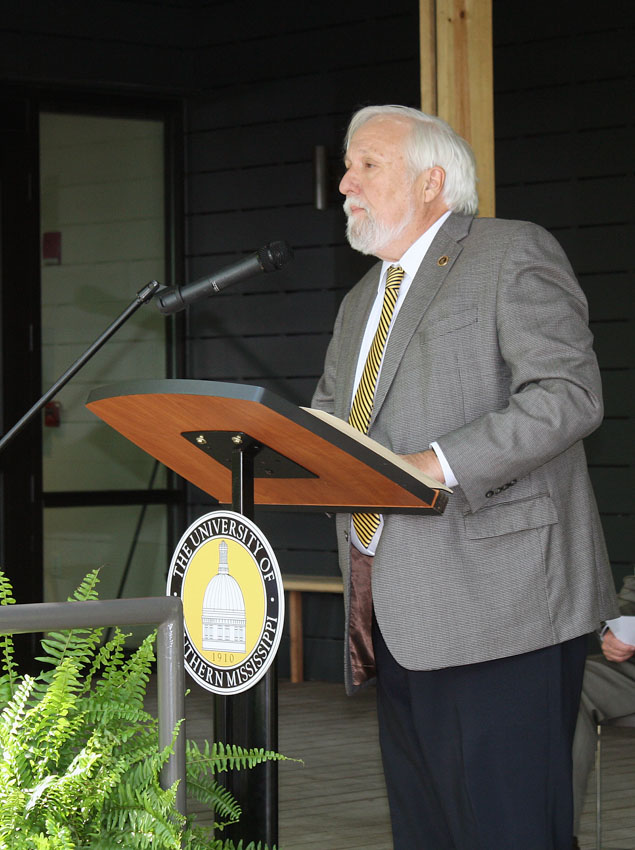
Cannon at the ribbon cutting for the Marine Education Center at USM’s Gulf Coast Research Laboratory, 2018
Dr. Joe Paul, president of The University of Southern Mississippi, noted Cannon’s dedication to student success.
“Gordon often shared that seeing how our students succeed after leaving our research labs was the highlight of his career,” said Paul. “He was an accomplished scientist and educator who prioritized personal relationships, mentoring students and colleagues alike. Gordon was a genuine friend to many in our community, and he will be dearly missed by his Southern Miss colleagues.”
Cannon had a unique way of connecting with students, understanding what mattered to them, and encouraging them to grow, succeed and give back. An example of his and Heinhorst’s shared commitment to Southern Miss students is the Cannon Heinhorst Research Endowment in support of undergraduate researchers in the Southern Miss Honors College and is an enduring legacy of his devotion to student success.
In 2011, Cannon began his administrative tenure as associate vice president for research and was named vice president for research in 2012, a role he held for a decade. Before retiring, he served as provost and senior vice president for academic affairs, rounding out his journey of dedication to the institution.
During his time as vice president for research, he transformed the university’s approach to scholarly excellence by investing in the people who facilitate and execute research. His strategy focused on future planning for research start-up packages for new faculty, enabling seed grants to help early career researchers build a solid foundation for external funding, and targeting the strengths of the university for strategic gain. He pioneered connecting research, societal relevance, and economic development and embraced entrepreneurship. He strengthened government relations efforts to position Southern Miss to meet the pressing needs of the state of Mississippi.
His leadership also led to considerable gains in the fields of polymer science and engineering, ocean science and engineering, as well as nursing and health sciences.
Dr. Shannon Campbell, retired senior associate vice president for coastal operations shared, “It is hard to imagine what this university would be today if he did not have such a unique balance between ambition and strategy. I admired how he always had his three-ring binder of ideas, proposals, and written goals handy, to advocate for USM any moment opportunity struck.”
Cannon’s attention to the blue economy was particularly prophetic, as he developed research and industry partnerships driven by new ideas and perspectives. His leadership launched Gulf Blue, an innovation-based economic development strategy connecting private-sector companies to the university’s research expertise in the blue economy. He set into motion the expansion of infrastructure for USM’s Gulf Coast teaching and research sites, including facilities for toxicology research, marine education and ocean engineering.
His lifelong interest in the ocean was the spark that ignited the university’s ambition to provide access to research for new generations of ocean scientists. Cannon worked to secure funding to build the Roger F. Wicker Center for Ocean Enterprise, a national hub for ocean innovation, and oversaw the acquisition of research vessels Point Sur and Jim Franks. These endeavors will enable USM to support the operation of the National Science Foundation ship Gilbert R. Mason, which is currently under construction. His commitment to growing the national profile of Southern Miss is credited with helping the university achieve the Carnegie Classification as an R1 institution in 2018 and has nurtured durable public-private partnerships that will fuel innovation and industry collaborations long into the future.
Dr. Kelly Lucas, vice president for research stated, “He was a mentor, a colleague, and a friend to many of us, myself included. He cared about helping others succeed; he showed up for you, supported your work, and celebrated your successes. His influence on this university and on the people who have worked here is significant and enduring.”
In retirement, he was actively engaged in service to a variety of boards, including the USM Research Foundation. He continued to support undergraduate research at the university through the Cannon Heinhorst research fund and through service; in his emeritus role, he read Honors theses, served as a judge for the Undergraduate Symposium on Research and Creative Activity, and provided feedback on initiatives dedicated to supporting undergraduate research in STEM at the institution. Retirement provided the opportunity for traveling to visit friends and colleagues, enjoying the outdoors, fishing, experimenting with cooking, and deeply connecting with his children and grandchildren, whom he considered his life’s greatest accomplishments. When he spoke about his family, as he often did, he radiated brilliant pride and infinite joy.
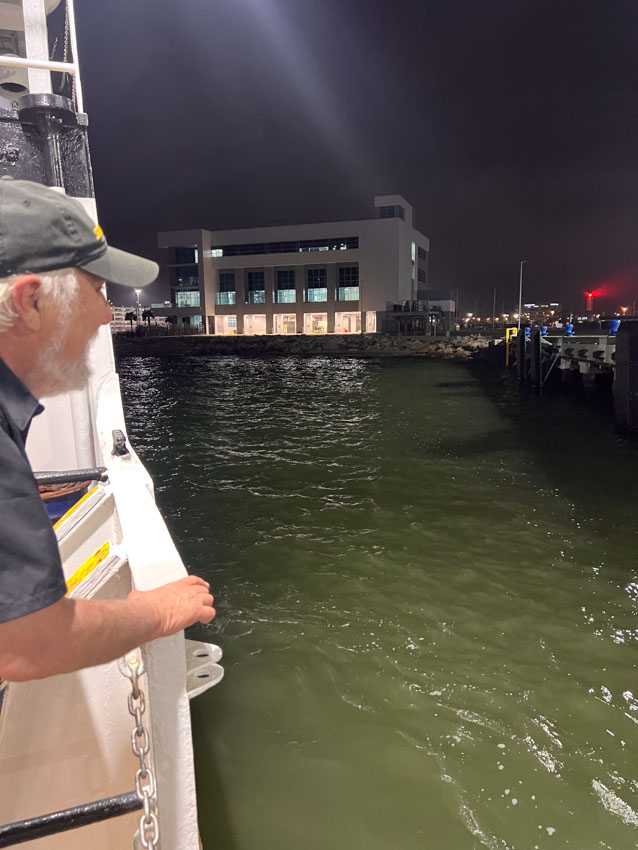
Cannon peering over the gunwale of R/V Point Sur looking towards the Roger F. Wicker Center for Ocean Enterprise, 2026
The opportunity to gather stories about a person whose life meant so much to so many is an enormous treasure – one that is only matched by an opportunity that occurred just weeks before Cannon’s passing. He was able to step away from his abundant life for a few days to sail on Research Vessel Point Sur alongside undergraduate and graduate students, staff and faculty. He was driven by insatiable curiosity – about science, how it was done, the people who did it, whom it helped, and how it furthered knowledge. At the conclusion of the expedition, the ship approached the research facility he envisioned years before. When asked to peer over the side of the ship and look at what he made, without hesitation, he said, “I only got it started. What I made are the people who saw it through.” He was talking about his students, mentees, colleagues, successor, and every person that rolled up their sleeves with him in service to the university. That humble grace captured who he was, and why so many sought the gift of his wisdom, the cleverness of his words, and the warmth of his friendship. He leaves an indelible mark on our future and our hearts.
A celebration of Dr. Cannon’s life and immense impact will be planned for a later date. In lieu of flowers, the family requests donations be made to the Cannon Heinhorst Undergraduate Research Endowment (Fund 2346) to support the research endeavors of undergraduate Honors students. Gifts in memory of Dr. Gordon Cannon may be made online.