Center for Faculty Development
Spring 2026 A.I. Workshop
Page Content
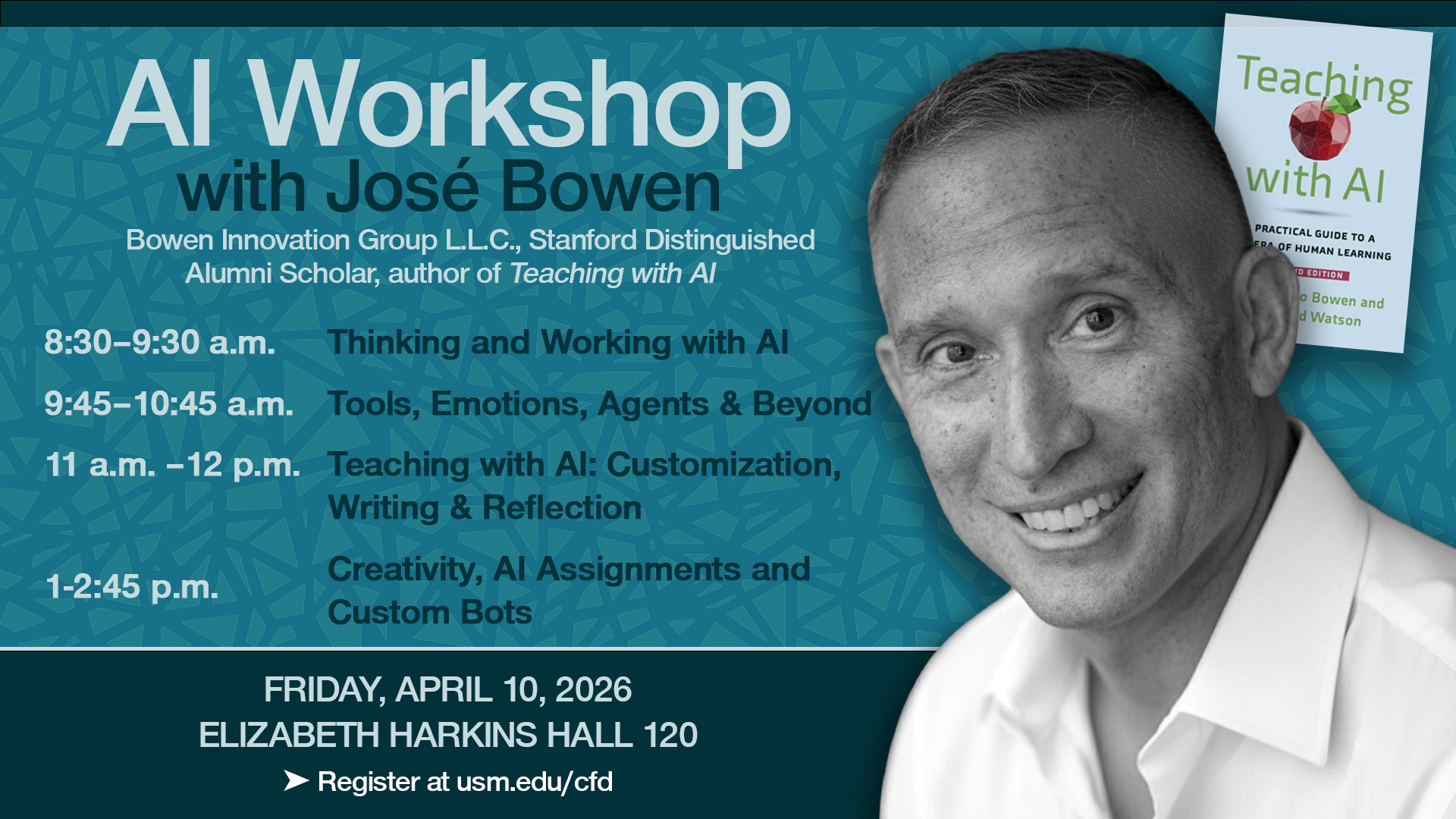
Friday, April 10, 2026
EHH 120
About José Bowen

José Antonio Bowen has been leading innovation and change for over 40 years at Stanford, Georgetown and the University of Southampton (UK), then as a dean at Miami University and SMU and as President of Goucher College. Bowen has appeared on five continents as a musician and has performed with Stan Getz, Dizzy Gillespie, Bobby McFerrin, Dave Brubeck, Liberace, and many others. His compositions include a symphony (nominated for the Pulitzer Prize in Music in 1985), and music for Jerry Garcia. Bowen holds four degrees from Stanford University (in Chemistry, Music, and Humanities) has written over 100 scholarly articles, is editor of the Cambridge Companion to Conducting (2003), and an editor of the 6-CD set Jazz: The Smithsonian Anthology (2011). He received a National Endowment for the Humanities Fellowship and has three TED talks. In 2010, Stanford honored him as a Distinguished Alumni Scholar.
His books on teaching include Teaching Naked (2012) winner of the Ness Award for Best Book on Higher Education, Teaching Change: How to Develop Independent Thinkers using Relationships, Resilience and Reflection (2021) and his latest book with C. Edward Watson, Teaching with AI: A Practical Guide to a New Era of Human Learning (2024; 2nd edn 2026).
Bowen was given a Stanford Centennial Award for Undergraduate Teaching in 1990 and he has presented more than 500 keynotes and workshops in 47 states and 24 countries around the world. He has been featured in The New York Times, Forbes, The Wall Street Journal, The Chronicle of Higher Education, PBS News Hour, and on NPR. For more, see his website teachingnaked.com or his education TED talks.
In 2010, Stanford honored him as a Distinguished Alumni Scholar and in 2018 he was awarded the Ernest L. Boyer Award for significant contributions to American higher education and is now a senior fellow for the American Association of Colleges and Universities. He lives in Dallas and also does innovation and inclusion consulting for a wide variety of Fortune 500 companies.
Workshops
8:30-9:30
Workshop 1. Thinking and Working with AI
AI is already changing human work and thinking. AI is a new form of labor and you and your students will now always be an AI boss. AI Literacy, however, involves two staples of higher education: asking better questions and evaluating answers. This workshop explores AI bias, the range of models (that includes dozens of different regional and cultural models) and what new capabilities (like searching for ideas) means for what AI can do for you. It is critical to determine for which tasks it is useful and for which it is not. Equally, humans will need to understand where human expertise remains essential and when and how human skills make AI responses better.
9:45-10:45
Workshop 2. Tools, Emotions, Agents & Beyond.
To understand the AI ecosystem, possibilities and threats, we also need some understanding of the thousands of other AI and API tools designed to only search published research, support neurodivergent students, respond emotionally or clone your voice. We will examine how system prompts and a course profile can expand perspectives, predict responses and help you customize at scale. New agents, browsers and stackable skills, far surpass what chatbots can do. They can design and deploy an interactive simulation for your students, give oral exams, or organize your research files, but they can also complete online assignment. Practicing with these rapidly-evolving tools will help us determine which tasks might be done better with AI and where we must preserve human judgement and expertise.
11-12
Workshop 3. Teaching with AI: Customization, Writing & Reflection
Prompting is writing. We can create a wide range of new writing assignments that both use AI and challenge students to do better work than they could without AI. If an AI can produce consistent average and customized work than we need to update our policies around grading: why would an employer hire a “C” student if AI can do that level of work? We will examine how AI might help us improve our teaching, enhance critical thinking, increase student reflection and explore new post-AI writing assignments.
1-2:45
Workshop 4. Creativity, AI Assignments and Custom Bots
All assignments are now AI Assignments. In the same way that the ease of finding information on the internet forced faculty to rethink what homework students did and how we wanted them to do it, we will all need an AI strategy for assignments. We will focus on how we can create assignments that foster and protect critical thinking and human agency while also raising standards. We will learn how to create and use custom bots and through a wide diversity of examples, explore how we can redesign to reduce cheating and prepare students for a new world of AI-assisted work.
 |
 |
 |