Skip navigation

School of Humanities

GEC 03 Variable Topics in English and History

Page Content
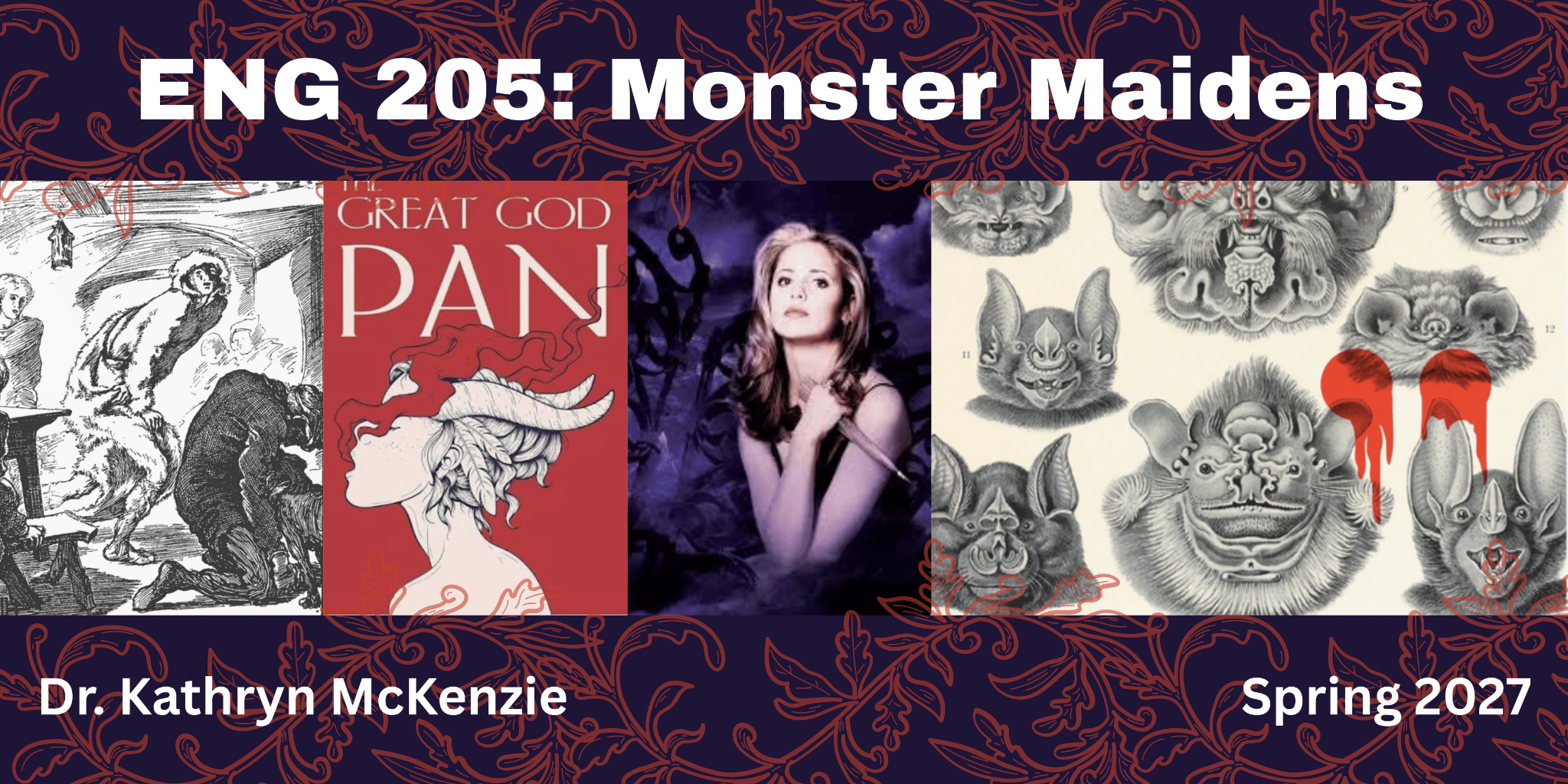
ENG 205 (H001) 
Gothic Literature 
Dr. Alexandra Valint 
T/Th 9:30am – 10:45am  
This section of ENG 205 introduces you to gothic literature from across the globe. Gothic literature features hauntings, ghosts or monsters, secrets from the past, mysterious dreams, and old and spooky settings. Authors use the gothic mode to reveal and explore characters’ and cultures’ fears, anxieties, and desires. We will analyze and compare how authors from different time periods and locations (such as Japan, Mexico, India, Nigeria, England, and the United States) employ the gothic mode. Likely readings include various short stories and poems, as well as the gothic novel Anya’s Ghost (by Vera Brosgol) and the novels The Haunting of Hill House (by Shirley Jackson) and Mexican Gothic (by Silvia Moreno-Garcia). Throughout the course, we will learn about the gothic mode (its tropes, characteristics, and subtypes), practice interpreting and close reading literature, and write short essays analyzing our course texts. 
 
ENG 205 (H002) 
Literature and Youth 
Dr. Eric Tribunella 
M/W 11:00am – 12:15pm 
This section of ENG 205 (Literature and Youth) considers how literature for or about young people represents and constructs youth cultures, teen concerns, and adolescent experiences. Students will read a selection of junior, young adult, and new adult novels to understand the operation and value of narrative storytelling and poetic language, and the class will investigate how this literature reflects and illuminates the history, construction, and experience of adolescence and early adulthood. We will read a variety of genres including historical fiction, the realist novel, gothic fiction, dystopian fiction, fantasy, the verse novel, and the graphic novel. Readings may include the following: 
Let the Hurricane Roar, Rose Wilder Lane 
The Perks of Being a Wallflower, Stephen Chbosky 
Normal People, Sally Rooney 
Ravencave, Marcus Sedgwick 
Feed, M.T. Anderson 
The Hedge Knight, George R.R. Martin 
The Poet X, Elizabeth Acevedo 
This One Summer, Mariko Tamaki and Jillian Tamaki 
Where the World Ends, Geraldine McCaughrean 
 
ENG 205 (H003) 
Marriage in World Literature 
Dr. Nicolle Jordan 
T/Th 11:00am – 12:15pm 
What makes a marriage? Which kinds of relationships “qualify” as marriage and which kinds do not? What do we learn about the institution and the experience of marriage by reading literary depictions of it that range from approximately 2500 to 10 years old? Why has this centuries-old institution lasted so long, and how has it shifted to accommodate—or suppress — socio-cultural change? How does marriage assign value to certain characteristics while stigmatizing others? Students will explore these questions in warm-up writing exercises, online and class discussions, and in-class essays, thus deepening their understanding of a flexible, durable, and universal cultural institution. Texts include Genesis, Euripides’s Medea, Chaucer’s “The Wife of Bath’s Prologue,” Aidoo’s Anowa, Chang’s Love in a Fallen City, and Akhtar’s Disgraced
 
ENG 205 (H004) 
Latino/a/x Literature 
Dr. Luis Iglesias 
T/Th 1:00pm – 2:15pm 
From Bad Bunny to Guillermo del Toro, Latinx writers and artists have made impactful contributions to not only U.S. literature and society but also world culture. ENG 205: Latino/a/x 
Literature will explore the multiethnic, multiracial, and socially diverse dimensions of Hispanic literature. A rich and expressive category of internal differences, Latinx writing and culture are most frequently understood in relation to “the border” in a variety of stylistic, spatial, and metaphoric ways. This class will read a range of works across different genres as we unpack the term “Latinx,” which has come to represent a diverse set of communities from across the full spectrum of American life, experiences, and geography. At the same time, we will explore an exuberant and historically significant group of writers and texts that define “Latino/a/x” identity in the U. S. and beyond (and you might even learn to Salsa). 
Reading selections from: 
Christina Garcia, Dreaming in Cuban (1992) 
Javier Zamora, Unaccompanied (2017) 
Elizabeth Acevedo, Poet X (2018) 
Guillermo Reyes, Men on the Verge of a His-panic Breakdown (1999) 
Juliana Delgada Lopera, Fiebre Tropical (2020) 
Martin Espada, Imagine the Angels of Bread (1996) 
Brenda Peynado, The Rock Eaters: Stories (2021) 
 
ENG 205 (H005) 
On the Road 
Dr. Ery Shin 
M/W 1:00pm – 2:15pm 
This course is a survey of writings devoted to road trips, travel, and the spirit of adventure at large. The open road has been treated by generations of writers and thinkers as an invitation to self-discovery. Pushing the body and spirit beyond what feels comfortable and familiar can become, according to the individual, an act of escape, homecoming, defiance, affirmation, loss, and so on. 
SAMPLE READING LIST: 
Hunter S. Thompson, Hell’s Angels 
Mary Seacole, Wonderful Adventures of Mrs. Seacole in Many Lands 
Cheryl Strayed, Wild 
Yukiko Motoya, The Lonesome Bodybuilder (excerpts) 
Jon Krakauer, Into the Wild 

HIS 104 (H001) 
A Global History of Food 
Dr. Andrew Haley 
M/W 11:00am – 12:15pm 
Throughout history, the need to eat has created nations, sparked wars, and defined how we think about ourselves. This course explores historical case studies from the rise of agricultural communities to the McDonaldization of diets to consider how what we eat has shaped our past. How did the development of agriculture lead to the creation of sophisticated societies? Did the emergence of long-distance trade routes transporting food and spices shift the balance of global power? Do distinct cuisines play a part in the creation of nation-states? Why did some new technologies like canning contribute to war and others like high-yield grains contribute to peace? To answer these questions (and many more) we will explore the histories of various foods from rice, sugar, and tea; to chop suey, lasagna, and pickled herring; to tacos, Pad Thai, and mac and 
cheese. Each new dish will unlock a story about how food has become a measure of political power, cultural achievement, colonial domination, and inequality. Readings will come from a textbook supplemented by carefully selected, and very readable, articles. 
 
HIS 104 (H002) 
Putin’s War in Ukraine 
Dr. Brian LaPierre 
T/Th 1:00pm – 2:15pm 
Vladimir Putin’s war in Ukraine is about more than territorial gain and the recovery of lost empire. For both Ukraine and Russia, It is also a war over history itself—one in which conflicting narratives and memories of the past have been politicized, weaponized, and used to justify wholesale destruction, mass mobilization, and heroic resistance. In this course, students will take a deep dive into the historical roots of Russia’s war in Ukraine. Through the examination of diverse topics such as Russian imperialism, the collapse of communism, NATO 
expansion, and the post-communist transition, they will gain a better understanding of the deadliest war to hit Europe since World War II. In the process, students will also learn how history gets distorted as leaders manipulate the story of the past to suit their contemporary political agendas and make sense of the chaotic world that surrounds them. 
 
HIS 104 (H003) 
Gender History to 1500 
Dr. Laura Mammina 
M/W 2:30pm – 3:45pm 
What can gender and sexuality tell us about the ancient world? Quite a lot! From women weavers in Mesopotamia to Sappho and the Amazons in Greece to intersex people in the Middle Ages, HIS 104: Gender His to 1500 examines the emergence and development of gender, sex, and sexuality from humanity’s origins until the Age of Exploration. We will use gender as a lens through which to assess the growth of communities, civilizations, and empires, striving to understand when—and why—certain regions used gender as an instrument of oppression or liberation, and how women, intersex, and same-sex loving people navigated these communities. Throughout, we’ll examine women’s work, the place of women and intersex people in the major world religions, and women in politics, from female pharaohs in Ancient Egypt to the Mongol Queens of Genghis Khan’s empire. As we learn about these fascinating people from the past, we 
will also acquire knowledge about the stuff of history—names, dates, and events, but our primary goal will be to cultivate historical thinking through analyzing primary and secondary sources and synthesizing information to construct interpretations of the past. 
 
HIS 104 (H004) 
Baseball: A Global History 
Dr. Ken Swope 
T/Th 9:30am – 10:45am 
This course will trace the history of baseball from its creation in the nineteenth century until the present day. We will discuss baseball’s evolution into America’s national pastime and look at how developments in baseball mirrored social and economic changes taking place in the United States as well as how the game has impacted peoples and economies in other parts of 
the world, most notably Latin America and Asia. Students will learn how baseball has become a global sport and discuss the implications that transformation has for the future. Topics covered include the origins of the game, its transformation into a professional sport, the creation of the American & National Leagues, baseball’s role in fostering civic pride and rivalries, baseball’s role in helping American society integrate, and how baseball has continually reflected social values, issues and concerns. We will also examine how the game has evolved on the field from the dead ball era to today’s game of power slugging designated hitters. Students will gain an overview of the history of the game itself, its greatest players, managers, and chroniclers and see how the issues of the game reflect larger social and economic trends. For as the preface to our textbook notes, “The story of baseball is also the story of race in America, of immigration and assimilation; of the struggle between labor and management, of popular culture and advertising, of myth and the nature of heroes, villains and buffoons; of the role of women and class and wealth in our society.” Students will also learn how to appreciate baseball from the perspective of a historian as well as a fan. Writing and analytic skills will be honed by reviews, writing assignments, and essay exams. 

Contact Us

School of Humanities

305 Liberal Arts Building (LAB)
118 College Dr. #5037
Hattiesburg, MS 39406

Campus Hattiesburg

Campus Map

usmhumanities@usm.edu

Phone
601.266.4320