School of Interdisciplinary Studies and Professional Development
Interdisciplinary Investigations
Page Content
2027-2028 Interdisciplinary Investigations Grant
Submit by 5pm, April 30, 2027
Grants of $5,000 are available to fund community-engaged research or creative activities, ideally within the 2027-2028 fiscal year. The funds may be used to support costs associated with research or creative activities such as travel to research sites, data collection, and data analysis. The money may also be used for stipends if that is preferred. In addition, up to $2,000 conference travel support will be available during or after the initial funding year for a total of up to $7,000 per grant.
The aim of this grant is to encourage cross-disciplinary collaboration to address community-identified needs, enhance community capacity to solve pressing challenges, and to involve the next generation of engaged scholars.
Successful proposals will include:
- Two to three faculty members from different disciplines
- At least one undergraduate research assistant
- An identified community partner
Proposed projects should adhere to the principles of community-based research with faculty and community members working collaboratively to conduct research for “the purpose of solving a pressing community problem or effecting social change” (Community-Based Research and Higher Education, Strand et al., 2004, p.3). The collaboration should incorporate best practices and principles of campus-community partnerships (such as those outlined in CCPH’s Principles of Partnership).
Proposals should include:
- Project overview: Clearly define the community issue, its relevance to Mississippi or the Pine Belt region, and anticipated benefits for community stakeholders
- Project team: List all faculty participants with School/program affiliations and identify a project contact
- Roles and contributions: Briefly describe each faculty member’s role in the project and the role of the undergraduate research assistant
- Community partner support: Letter from a partner outlining their interest and how the project aligns with their needs
- Budget: Preliminary budget, including any additional funding sources (if applicable)
- Administrative support: Brief email or memo from each relevant School Director confirming support for faculty participation
Criteria for selection
- Potential for and extent of impact on a) underserved communities or b) students' civic responsibility
- Feasibility of project
- Project innovation
- Applicants’ previous experience with community engagement
- Thoroughness of application
- Potential for sustained campus-community engagement
|
Please submit proposal by 5pm on April 30, 2027, to Dr. Ann Marie Kinnell, Director, School of Interdisciplinary Studies & Professional Development. Questions about the grant can be addressed to Ann Marie Kinnell or Christy Kayser, Director, Center for Community Engagement. Contact Information: Ann Marie Kinnell, 601-266-4496, ann.kinnellFREEMississippi Christy Kayser, 601-266-6467, christy.kayserFREEMississippi |
Past Interdisciplinary Investigations Series Projects:
The current iteration of Interdisciplinary Investigations focuses on community engaged research. More information about the inaugural 2022-2024 series can be found here: New Interdisciplinary Projects Planned for Community-Engaged Research Initiative
The 2021-2022 series, Medical Encounters, was organized by four faculty members:
- Dr. Emily Stanback, Associate Professor of English, School of Humanities
- Dr. Kathryn Anthony, Associate Professor of Communications, School of Communications
- Dr. Ian Dunkle, Assistant Professor of Philosophy, School of Humanities
- Dr. Michelle McLeese, Assistant Teaching Professor of Sociology, School of Social Science and Global Studies
Information about their two events and their course can be found at their website: https://usmmedicalencounters.hcommons.org/
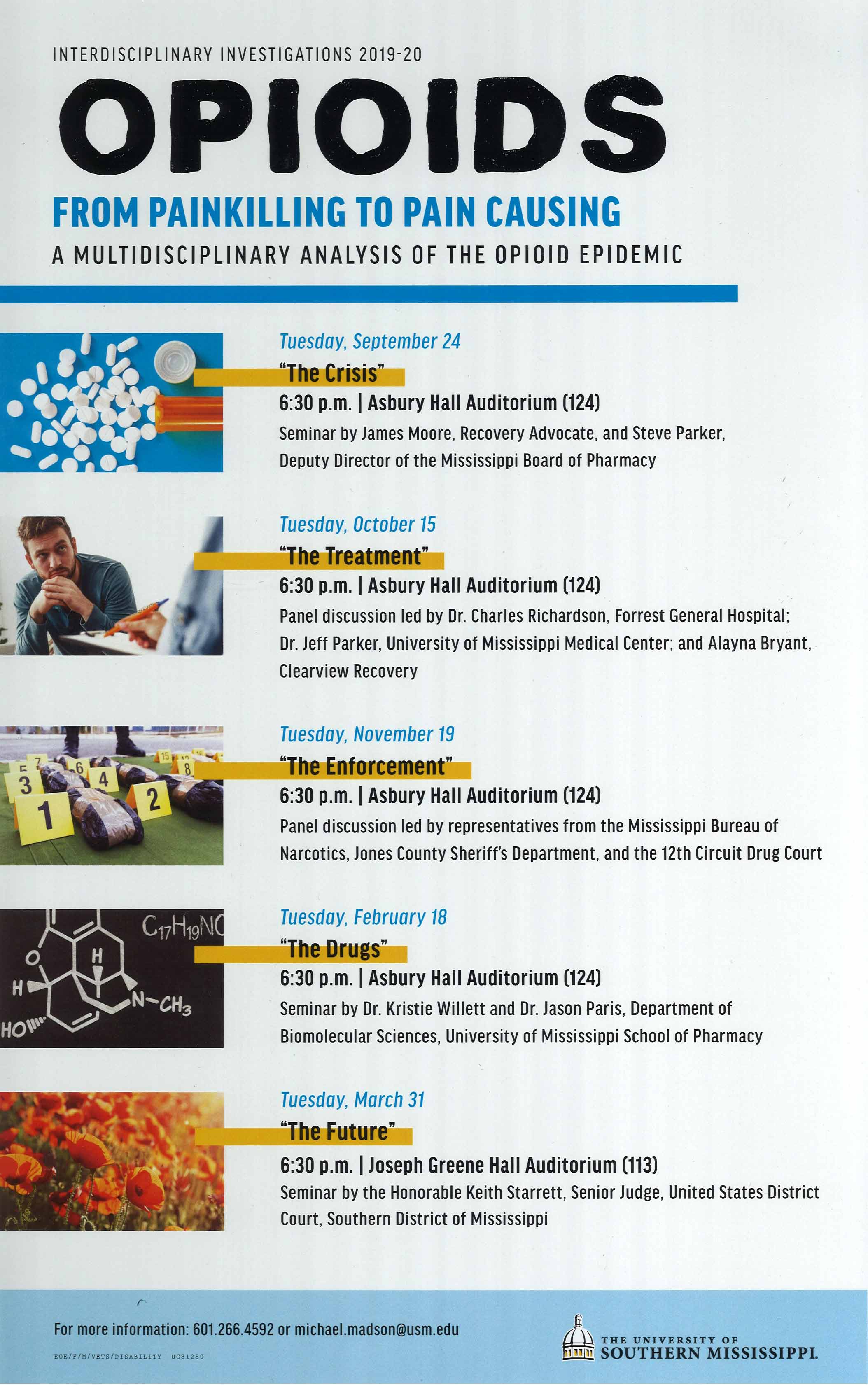
Proposal: Topics included:
(1) history of uses, including religious, medical, and recreational uses;
(2) sources of drugs, such as opium poppy plants in this case;
(3) the mechanisms of action, or pharmacology, of drugs in reducing pain;
(4) the legal and illegal business of producing, marketing, and selling drugs;
(5) intervention and the treatment of addictions;
(6) the public policy of dealing with drugs, drug users, and drug dealers.
Coordinators: Mac Alford, Biological, Environmental, and Earth Sciences; Ragan Downey, Criminal Justice, Forensic Science, and Security; Michael Madson, Psychology; and Julie Pigza, Mathematics and Natural Sciences
Spring 2020 course: IDS 350-H002 (8505), TTh 1:00p.m. - 2:15p.m.
Topic: Opioids: From Painkilling to Pain Causing, A Multidisciplinary Analysis of
the Opioid Epidemic.
Instructors: Mac Alford (Biology), Michael Madson (Psychology), Ragan Downey (CJ/Forensic
Science)
This class considered opioids and the opioid addiction crisis from the angles of history, medicinal plants, chemistry/pharmacology, pain treatment, addiction interventions and treatments, medical professional training, policies and practice in criminal justice, and societal impact. Students developed a multifaceted view of, and be better prepared to help address, this important and timely public health epidemic.
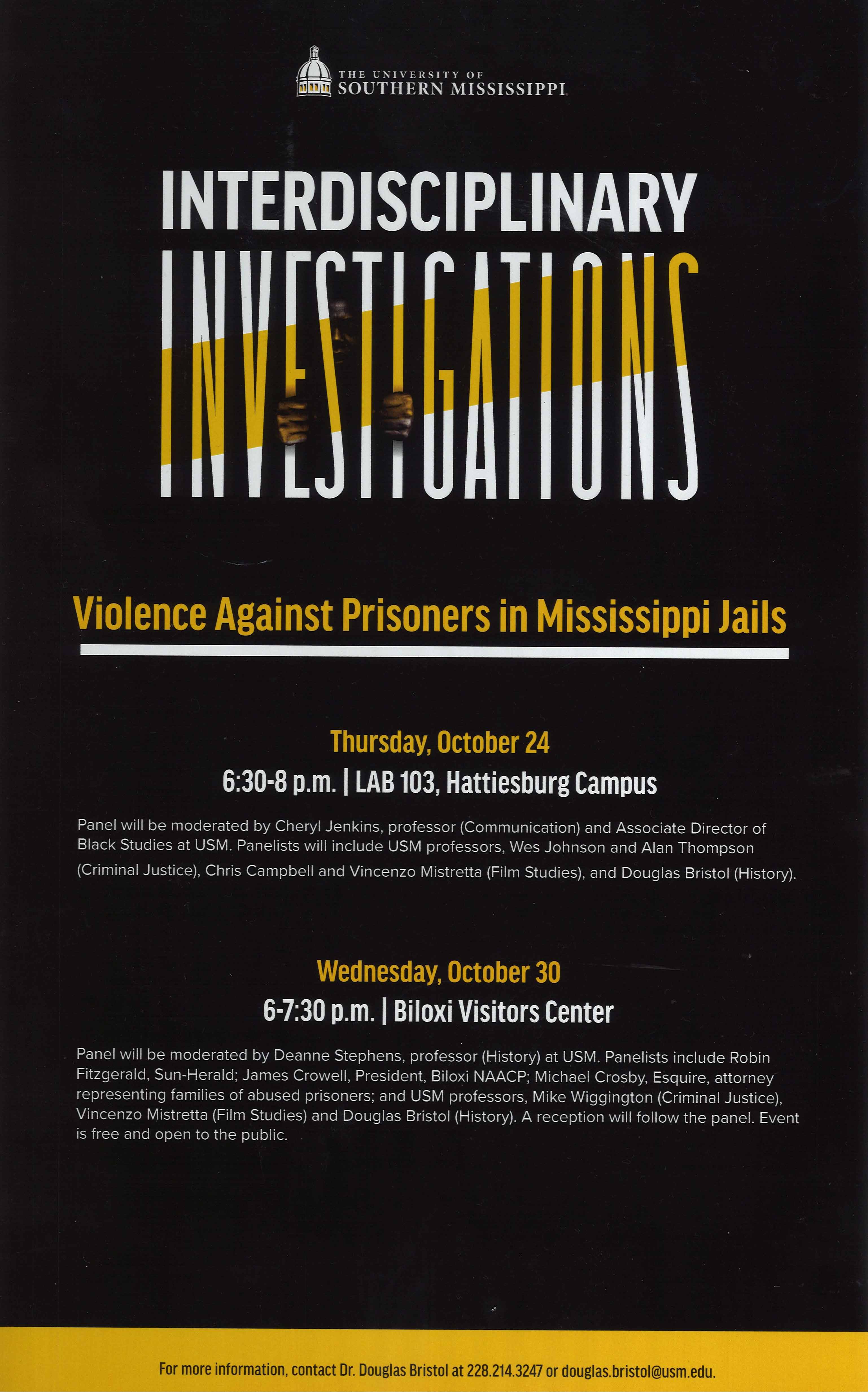
Proposal: This project investigated civil rights and social justice issues in Mississippi jails through an examination of the conditions within jails and the opportunities for reform. The series included a documentary being made by undergraduate students as well as through panels featuring civil rights leaders, law enforcement officials, reporters, and Southern Miss faculty members.
Coordinators: Douglas Bristol, Humanities; Vincenzo Mistretta, Communication; Team: Deanne Stephens, Humanities; Chris Campbell, Communication; Cheryl Jenkins, Communication/Black Studies; Wes Johnson, Criminal Justice, Forensic Science, and Security; Alan Thompson, Criminal Justice, Forensic Science, and Security; and Michael Wigginton, Criminal Justice, Forensic Science, and Security
Proposal: This project investigated aspects of Native American life and ways in the Gulf South from ancient to contemporary times, using a variety of research methods and sources. Faculty and students examined ethnographic and qualitative data collection as well as perspectives on indigenous life collected from primary colonial sources (Spanish, French, and English)
Coordinators: Tammy Greer, Psychology; Joshua Haynes, Humanities; Jeanne Gillespie, Social Science
and Global Studies; Team: Bridget Hayden, Social Science and Global Studies; Jennifer
Lemacks, Kinesiology and Nutrition; Deanne Stephens, Humanities
Spring 2020 course: IDS 350-H001 (8163), MW 1:00p-2:15p, HYBRID
Topic: In the Footsteps of the Ancestors: Native American Travel, Trade, and Natural
Resource Use in the Gulf South
Instructors: Jeanne Gillespie (World Languages), Tammy Greer (Psychology), Josh Haynes
(History)
Come learn about our American Indian heritage along the Gulf Coast. Did you know Pascagoula, MS has been a city known for boatbuilding for more than 5000 years? Did you know tamales got to Mississippi before Europeans did? Did you know that some of the first contacts between Europeans and American Indian communities occurred in our region and that there are archives filled with documents describing American Indian ways of life and cultures in Spanish, French and English? If you are interested in exploring more about these questions and the lives of our American Indian neighbors, take IDS 350.
 |
 |