Southern Miss Students and Faculty Explore Energy, Sustainability in Africa
Tue, 09/08/2026 - 01:34pm | By: David Tisdale
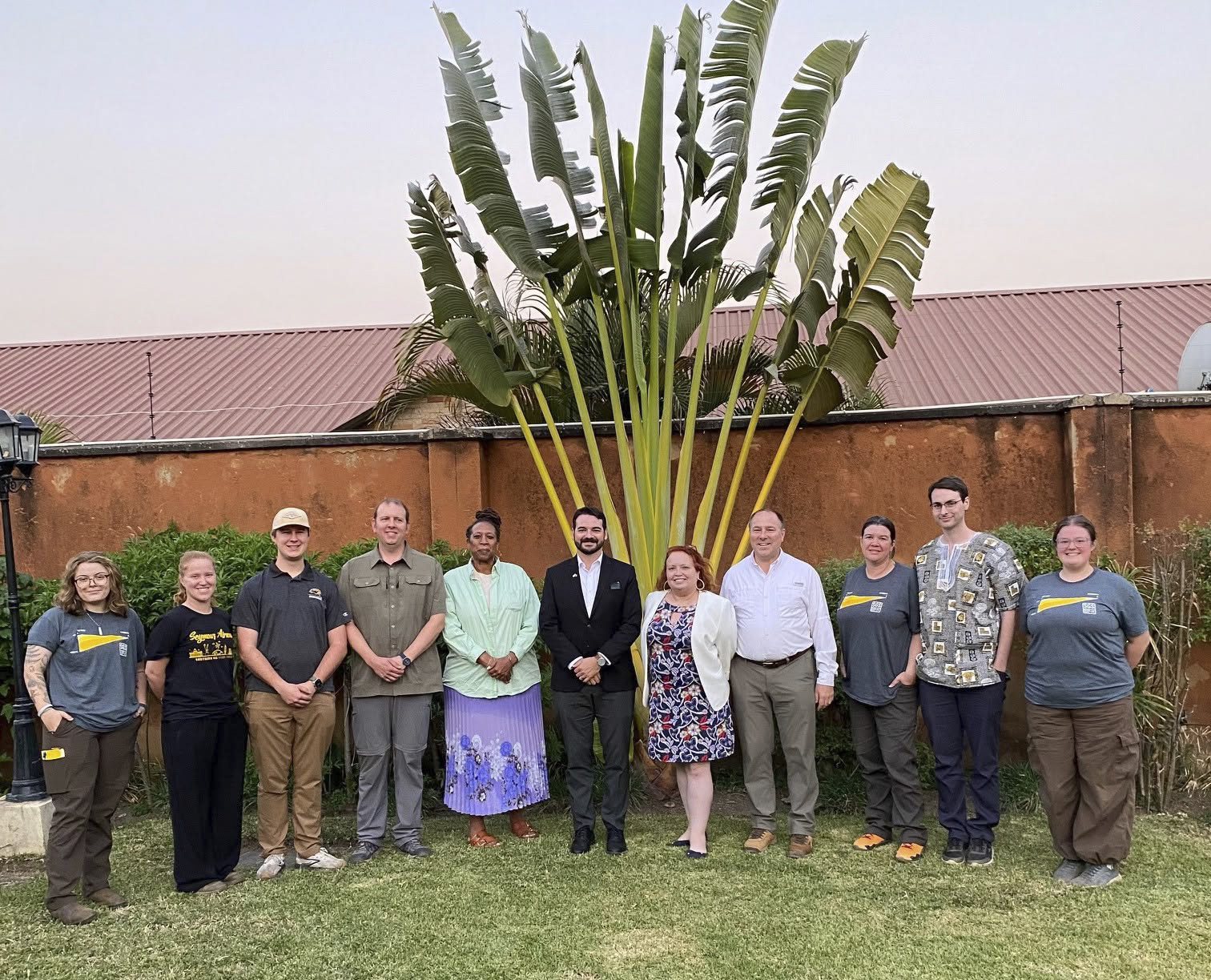
University of Southern Mississippi students and faculty in the School of Biological, Environmental and Earth Sciences witnessed firsthand how Zambia and Namibia balance use of their energy resources
and employ conservation strategies during the school’s inaugural Study Abroad program on the African continent.
“Energy and Natural Resources in Africa,” held July 2-25, included three Southern
Miss faculty members and six students studying metals, mining, electricity generation
and use, and the biodiversity of miombo woodlands, savannas and deserts in the two
Global South countries. The group also learned about stakeholder approaches and challenges
surrounding conservation and the use of natural resources.
The program was supported in part by an IDEAS (Increase and Diversify Education Abroad
for U.S. Students) grant from the U.S. Department of State.
Dr. Mac Alford, professor of botany and coordinator of the historic summer program,
was joined by faculty colleagues Dr. Jeremy Deans, associate professor of geology,
and Dr. Kayla Stan, assistant professor of geography.
Alford said the Africa Study Abroad program is yet another example of how the university’s
commitment to international education enhances both the student and faculty experience
at Southern Miss.
“Our travels to Zambia and Namibia richly benefited both students and faculty who
took part in this historic first study abroad to Africa for the university,” Alford
noted.
“For the students, it was an eye-opening experience to be on the continent for the
first time and to learn about energy and sustainability issues in other countries.
It also offered research benefits for both the students and accompanying faculty.”
Sandra Moss is pursuing a Ph.D. in STEM (science, technology, engineering and mathematics)
Education at Southern Miss. The Philadelphia, Pa., native’s research centers on sustainability
and climate change, helping K-12 teachers use place-based education to teach STEM,
sustainability and climate science through real-world problems. Therefore, the Africa
Study Abroad program’s focus on energy was a strong draw for her.
“Understanding how countries produce, manage and transition their energy systems is
key to understanding sustainability and climate resilience,” Moss explained. “Reading
about these topics is helpful, but getting the chance to learn directly from the people
designing and implementing large-scale energy projects in Namibia and Zambia was an
opportunity I couldn’t pass up.”
One of the biggest takeaways from the program for Moss was learning about the complexities
of mining and energy production and seeing the engineering design process in action
as communities worked through environmental, economic and social trade-offs to solve
complex problems.
“Although I knew it intellectually, seeing it firsthand honestly brought the realization
home,” she said. “Every solution comes with trade-offs, and seeing that up close really
expanded my perspective. It reaffirmed my belief that authentic, immersive learning
has the power to transform the way we think and is exactly the type of experience
I hope to have for K-12 students, meeting them where they are while opening their
eyes to the possibilities beyond the classroom.”
As co-PI for the U.S. State Department grant supporting the Africa Study Abroad program,
Deans’ role included grant formulation and writing, as well as serving as an instructor
for the course.
Deans said much of the current “green” energy transition (shift from fossil fuels
to renewable energy sources) is through mining of critical minerals and elements.
Zambia, he noted, has one of the largest deposits of copper in the world, while Namibia
has one of the largest uranium mines in the world, making them important state actors
in this transition.
“Southern Africa has a very interesting geologic history, distinct in many ways from
much of the history we see in the U.S.,” Deans explained. “I was able to provide geologic
context for our students, as well as help them navigate visits to mines, while also
providing background on the geology related to hydroelectric dams.”
Deans extensively researched the geologic history of southern Africa in advance of
the trip, broadening his understanding of different types of geologic processes. The
group also collected rock samples to show other students and help them visualize these
broader processes.
“The students in the program learned about different styles of tectonics, saw new
rocks and experienced a more economic geology focus, which we do not provide as much
in our current curriculum,” Deans said. “They saw a mature mine that has been open
for decades and is all underground, a mid-term mine that is open pit, and a mine in
the planning stages.”
“All of that was in addition to getting the experience of traveling to another country,
one that many people do not go to, experiencing their culture and food, and seeing
firsthand what an energy transition really requires.”
Deans said one of the main impressions he took from Namibia and Zambia was the sheer
size of both countries.
“They are smaller than the U.S., but bigger than most states,” he noted. “The contrast
between the two countries lies in their population, with Zambia having a larger population
and with that the growing pains of infrastructure development. Everywhere we went,
they were trying to fix old roads and build new roads with a steady stream of trucks
and people trying to get through.”
Namibia has a much smaller population than Zambia, Deans said, and has catered to
outdoor adventures, a style of tourism evident and distinct from Zambia. Both countries,
however, are dependent on their critical minerals and elements in raw form but, ironically,
must buy back the finished product. For example, raw copper is produced by both, but
they must buy copper wire from other nations that costs more than the raw product
found at home.
“As they try to expand and keep up with global demand, this will grow their economy,
but they will always be challenged as they try to trade and buy finished goods from
abroad,” Deans explained. “This growth also requires capital, which is mostly found
from the U.S., Europe and China, which are also very interested in securing reserves
of these minerals and elements.”
“These issues are frequently in the news, but seeing it on the ground makes it real
and challenges you to understand the local and global system.”
The Study Abroad in Africa program challenged participating students and faculty to
examine their preconceived notions of Africa in general, and Zambia and Namibia specifically,
while allowing them to explore the challenging and growing issues surrounding an energy
transition.
“For example, Zambia has the majority of exploitable copper in the world, and Namibia
has one of the largest uranium mines in the world — both elements used for the generation
of electricity,” Deans pointed out, “yet both countries have between 40-50% of their
population without electricity.”
Stan served as a specialist in energy and green energy production for the program,
with her research expertise including the examination of sustainable development and
the intersection of the natural environment and government policies and regulations.
“Our program showcased how various countries are interacting with power production,
how weather factors such as El Niño and severe droughts may impact local energy production,
as well as how regional power agreements fit in with some of my teaching and research
work,” Stan said.
Stan’s research also focuses on tropical dry forests, prevalent in Zambia and, to
some extent, Namibia, with the landscape ecology of these regions also fitting within
the scope of her expertise. While in both countries, she was able to build new collaborations
with academics in Zambia, as well as potential government and industry research partners
in both Zambia and Namibia.
“There was an interest in building collaborations on both sides, potentially leading
to new research avenues and experiences for the university,” she noted. “On-the-ground
learning in Zambia and Namibia can also be brought back into the classroom, particularly
within Sustainable Development and Planning and Economic Geography.”
Stan was also encouraged by how student participants on the three-week journey benefited
from seeing various approaches to power production and resource management in the
two countries, and how the timing of mining activity leads to different focuses, outcomes
and technological priorities.
“In each place we visited with students, they also interacted with high-level professionals
and saw how they work and what novel solutions they develop for the challenges they
face,” Stan recounted. “This kind of interaction with people from around the globe
provides insights you cannot get in the classroom alone.”
Moss said her experience in Africa reminded her of the power of place-based education.
“Our time in Africa showed how the world truly can be the classroom,” she said. “Every
site visit, conversation and community interaction offered lessons that no lecture
alone could provide. I've returned to Southern Miss with new research ideas, new professional
connections, and a lot of stories and examples I can bring into my teaching and work
with educators.”
About the College of Arts and Sciences
The College of Arts and Sciences at The University of Southern Mississippi is home to 13 schools, two ROTC units,
and more than 100 academic programs. Guided by the University’s mission, we educate
students, lead the state and nation in research and the creative arts, and advance
knowledge across the humanities, social sciences, and STEM. Through innovative research
and nationally recognized student success, we provide pathways to understanding the
past, solving today's challenges, and imagining the possibilities of tomorrow.