Office of the Provost
Artificial Intelligence
Page Content
A.I. Vision Statement
The University of Southern Mississippi (USM) recognizes that Artificial Intelligence (AI) is a transformative force in learning, society, and industry. As a community-focused, Carnegie-ranked R1 research university, we are uniquely positioned to ensure our students develop and hone their capacity for critical thinking, curiosity, and ethical questioning when they do engage with AI, while also being prepared to succeed in their chosen disciplines and professional ambitions.
Guided by our commitment to integrity and ethical learning, USM relies on the disciplinary expertise of our faculty to guide students through decisions regarding appropriate and ethical use and application. It is the university's responsibility to foster an environment that supports informed decision-making by ensuring faculty, staff, and students have access to the training, resources, technology, and mentorship needed to meet the expectations and standards of their respective disciplines.
Our approach will foster an inclusive and collaborative environment where students, faculty, staff, employers, and the broader community engage in meaningful discourse and innovation. Through responsible, thoughtful, and strategic dialogue about the ways AI will affect teaching, research, and service, we aim to create opportunities that inspire critical thinking and lifelong learning, advance economic development, and prepare graduates who are truly “Ready for Life.”
New Elective Course Offering
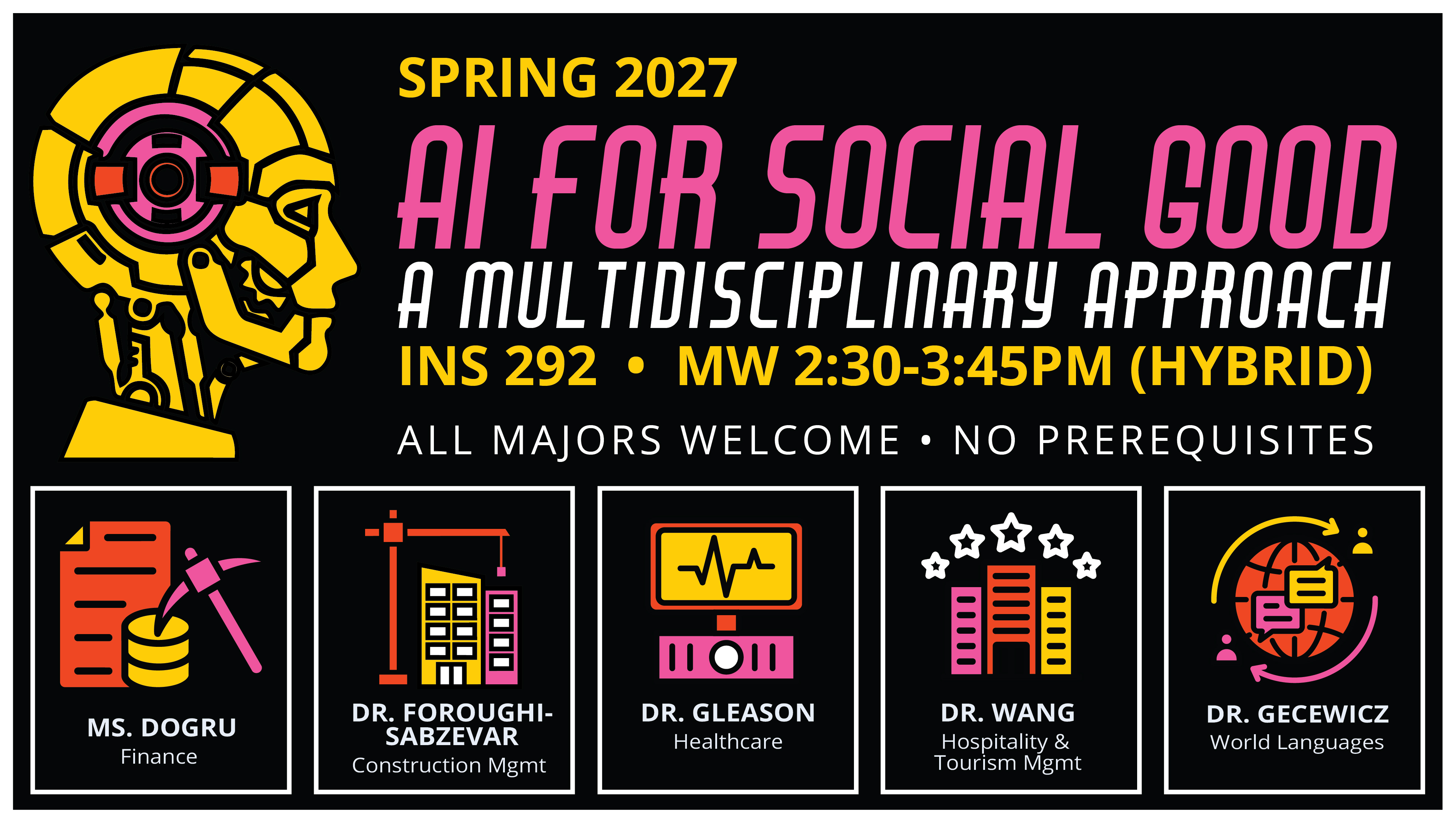
AI-Powered Analytics for Social Good
Ms. Ozlem Dogru
 This module explores how artificial intelligence (AI) and machine learning (ML) can
be used to address real-world societal challenges through data-driven decision-making.
Students will gain hands-on experience with Generative AI and Orange Data Mining,
an intuitive drag-and-drop platform that allows users to build, compare, and interpret
machine-learning models without coding. Through applications in education, public
services, and housing, students will examine how AI can help identify schools that
may need additional support, improve the allocation of public resources, and better
understand housing affordability challenges. Along the way, students will also consider
important questions about data quality, bias, fairness, transparency, and human oversight,
learning how AI can support more responsible and socially beneficial decisions.
AI for Design and Construction: Improving Safety, Sustainability, and Project Performance
Dr. Mohsen Foroughi-Sabzevar
 This module introduces participants to applications of AI and related digital technologies
in design and construction, including computer vision, generative AI, sensors, robotics,
and digital twins. Through real-world examples, participants will explore how these
technologies can help address challenges such as worker safety, project delays, quality,
and sustainability. The module will also discuss the social impacts and responsible
use of AI in the built environment.
Hype, Hope, and the Future of Patient Care: AI in Healthcare
Dr. Chris Gleason

In this three-week module, you'll explore how artificial intelligence is transforming healthcare, from medical imaging and rehabilitation to patient monitoring and sports medicine. You'll discover what AI really is, examine tools already being used in clinical practice, and tackle important questions about accuracy, bias, ethics, and patient safety.
But you won't just study AI. You'll think like an innovator. Working with students from different healthcare disciplines, you'll design a conceptual AI solution to a real healthcare problem and explore how technology can improve patient outcomes.
No coding. No computer science background. Just curiosity and a willingness to think differently.
The future of healthcare isn't humans versus AI. It's healthcare professionals who know how to use AI wisely. Will you be one of them?
AI for Service Innovation: Ready for Business and Society
Dr. Wei Wang
 Artificial intelligence is reshaping how organizations serve people, understand customers,
make decisions, and solve problems. This interactive workshop introduces students
to three forms of AI: mechanical, thinking, and feeling AI, using real world examples
from service and marketing management. Students will explore how AI can support automation,
personalization, customer engagement, and decision making while also considering important
issues such as privacy, fairness, transparency, accessibility, and the human touch.
The workshop provides a practical framework for understanding how AI can be used responsibly
to create value for organizations, customers, and society.
Lost in Translation? AI, Language & the Human Connection
Dr. Chimene Gecewicz
 What happens when AI can communicate across languages with remarkable speed and fluency?
In this module, we will explore what multilingual AI can do, how we can decide when
to trust it, and what changes when AI begins to mediate human communication and learning.
Through hands-on experiences, debates, case studies, and a design challenge, we consider
a bigger question: If AI can do more, what should it do—and what should humans continue
to do? Along the way, we will examine questions of expertise, learning, equity, culture,
power, and the common good.


USM Responsible Use of Artificial Intelligence Guidelines
The University of Southern Mississippi (USM) recognizes the transformative potential of Artificial Intelligence (AI) in enhancing education, research, and administrative functions.
These guidelines establish a framework for the ethical, secure, and responsible use of AI at USM. The goal is to ensure AI tools and systems are used in alignment with the university’s values of academic integrity, data privacy, and transparency while fostering innovation.
USM AI Syllabus Policy
It is crucial to respect the diverse disciplines and varied viewpoints and priorities of our faculty, researchers, administrators, students, and the broader community impacted by The University of Southern Mississippi. While some courses and fields can use artificial intelligence as a meaningful tool, it is essential to consider that, like any other tool, it cannot be used for every type of educational endeavor and can likewise be misused or used in a way that does not further meaningful learning, development, and engagement within some fields.
The university values offering student experiences that demonstrate academic rigor, creativity, original research, and other aspects that are appropriate to each field, while ensuring aspects of shared governance, accountability, and academic freedom in regard to the work of the colleges, faculty, and the core of instruction. Instructors are encouraged to guide discussions with students about ethical use within the discipline and course perspective as well as to highlight the varied uses across courses at USM.
Over the past three semesters, reported academic integrity violations have increased significantly due to unauthorized use and misuse of artificial intelligence. Consider the challenges in artificial intelligence applications. One notable challenge lies in the sourcing and attribution of information. Uncited or improperly attributed material used by artificial intelligence algorithms undermines academic integrity and raises ethical concerns regarding the accuracy, creativity, and reliability of generated content. As such, it requires courses to have a defined policy on whether using artificial intelligence is permissible and, if permitted, a statement on how it will be cited when used to ensure the proper maintenance of academic integrity. Further challenges arise through the use of unreliable sources or “hallucinations,” which are the result of outputs that are inaccurate and based on perceived patterns in the large language models of artificial intelligence.
Given the nature of discussions and lack thereof between programs about the ethical use of, access to, and engagement with artificial intelligence, this addendum to the syllabus requirement is added to use as a preface to the existing usage level options for artificial intelligence (full usage, limited or outline usage, and no usage permitted). By including this preface in individual courses, we intend to ensure the varied use and acceptance of artificial intelligence is communicated across all fields to all students. This underscores the importance of each individual faculty member’s role in examining the policy as it is made in each course, and considering how this process may be problematic in certain creative endeavors.
Artificial Intelligence Usage Policy for Instruction – Implemented Spring 2024Policy as of May 6, 2025:For Students, to Be Included in SyllabusThis section of the syllabus outlines the acceptable use of generative artificial
intelligence (AI) tools in this course. Generative AI tools include types of artificial
intelligence technology that are “capable of generating text, images, code or other
types of content, often in response to a prompt entered by a user” (Hughes, 2023,
TechRepublic).
|
Mississippi Artificial Intelligence Network (MAIN) and USM Partnership
 USM began its partnership with MAIN in fall 2024. As the first and only statewide
AI initiative, MAIN takes a holistic approach to AI by focusing on AI education, workforce
training, and AI awareness initiatives.
Through our partnership, MAIN offers courses focused on AI for workforce in various
sectors, including K-12 education, higher education, business and industry. Participants
will learn about AI and gain the skills needed to integrate this knowledge into their
classrooms, research projects, awareness initiatives and business operations.
AI Courses
We are pleased to offer four courses through the MAIN and USM partnership:
Introduction to Artificial Intelligence (AI)
Introduction to Generative AI
Applied Ethics for AI
AI for Cybersecurity
These courses are available to University faculty, staff and students.
Register for asynchronous AI courses
The courses include an intake form that requests data about demographics and employment. The MAIN grant is supported by AccelerateMS (the Office of Workforce Development), and this data will be used to assess the grant’s impact on the state’s workforce.
MAIN AI Lab
 As a partner with MAIN, Southern Miss has established the MAIN AI Lab in Room 204
of Cook Library on the Hattiesburg campus.
The space is open during Cook Library office hours and faculty can reserve the space
for a class meetings.
The purpose of the AI lab, as described by MAIN, is “to provide a strong foundation
for institutions to grow organically over time, creating AI-ready workspaces that
are built for the future.”
The AI Lab at USM includes 6 computer workstations with the capacity to support the
integration and expansion of AI curricula.
Events
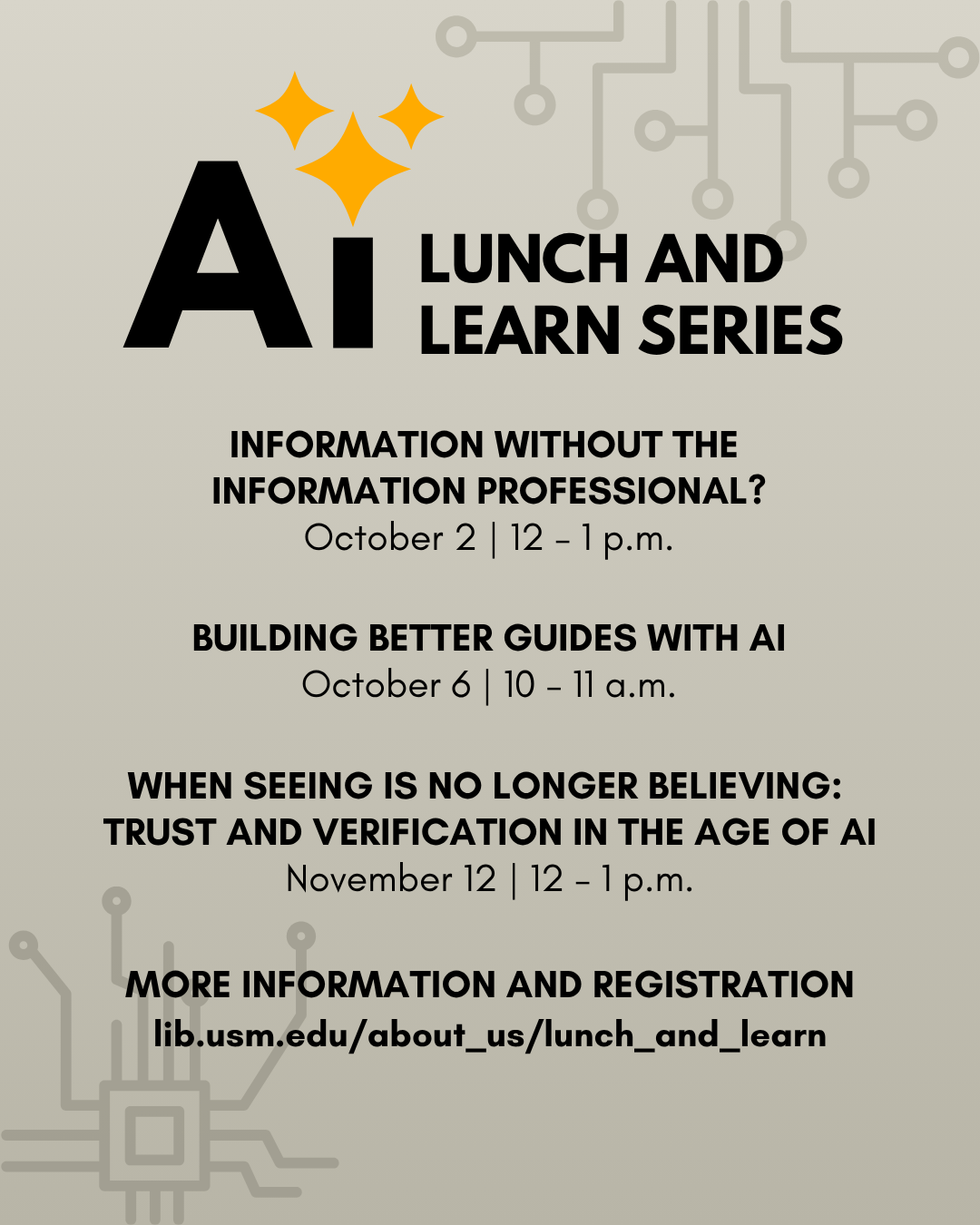 Join University Libraries for a virtual Lunch and Learn series exploring how AI is
reshaping information practices, from creating better research guides to navigating
questions of trust and verification.
Information Without the Information Professional?
October 2 | 12 - 1 p.m.
Sara Gonzalez
Building Better Guides with AI
October 6 | 10 – 11 a.m.
Dr. Shelby Ware and Sara Gonzalez
When Seeing Is No Longer Believing: Trust and Verification in the Age of AI
November 12 | 12 - 1 p.m.
Sara Gonzalez
AI Mini-Grants
The Library Al Access Program provides $150 mini-grants to help members of the Southern Miss campus community access an Al Pro tool for one semester. The program supports meaningful academic, research, creative, and professional projects.
As part of the application process, applicants will describe how their chosen Al tool will support their project or research and explain how they plan to use the tool during the Spring 2027 semester.
Applications open Sep 18 – Oct 23
AI Integration Grants
The Office of the Provost offers AI Integration Grants to support faculty in redesigning courses or academic programs to incorporate AI in ways that build discipline-specific skills and prepare students for an AI-informed workforce.
Application Submission Deadline: October 30, 2026
Teaching with AI
- Creative and Critical Engagement with AI in Education - The AI Pedagogy Project
- Generative AI Resources for Instructors - MSU
- Generative AI information - Cornell Center for Teaching and Learning
- Checklist for Assessing the Impact of Generative AI on your Course – UW Green Bay
- Generative Artificial Intelligence in the Classroom
- Free Retrieval Practice Learning Resources
- AI Literacy and Prompting from Teaching with AI by Jose Antonio Bowen and C. Edward Watson
- Includes descriptions and links to several generative AI tools and prompts for several tasks for instructors and researchers
- AI in Education Canvas Course - University of Sydney
- Includes background information on generative AI and prompts for learning, creating, and job seeking
- Student Guide to Artificial Intelligence by Elon University
Rethinking Course Assignments and Assessments
- Advancing Meaningful Learning in the Age of AI
- This resource by Oregon State University includes Bloom's Taxonomy Revisited to consider which types of assignments should likely be amended given AI capabilities.
- AI Assignments: 10 Best Practices for AI Assignments in Higher Edu
ChatGPT Resources
- How to Use ChatGPT
- What ChatGPT Brings Use for Item Writing for Assessments
- How to Write ChatGPT Prompts to Get the Best Results
- How to Write Better ChatGPT Prompts for the Best Generative AI Results
AI Tools
- AI Tools Directory
- AI Resources Canvas Site- Oregon State University
AI Taskforce
The AI Taskforce is composed of USM faculty who consider the challenges and impacts of artificial intelligence. The advice, concerns, and ideas from the AI Taskforce aid in the development of resources, events, and support for faculty, staff, and students at USM.
- President Paul's Charge to Committee August 2025
- AI Taskforce Faculty & Staff Development & Curriculum Recommendations
- View Taskforce Timeline
Office of the Provost
- Joanne Tran, Chair, Assistant Provost for Academic Affairs
- Kendrick Buford, Academic Integrity Director
Arts & Sciences
- Rabab Abdelfattah, Assistant Professor, Computing Science and Computer Engineering
- Hugh Broome, Associate Teaching Professor, MANS
- Kim De Mutsert, Associate Professor, Ocean Science and Engineering
- Jason McCormick, Assistant Professor, Humanities
- Michelle McLeese, Associate Teaching Professor, Social Science and Global Studies
- Jose Martinez Cruz, Assistant Teaching Professor, Computing Science and Computer Engineering
- Brian Olson, Assistant Teaching Professor, Polymer Science & Engineering
- Rebecca Powell, Associate Professor, Humanities
- Hilary Scales-Lewis, Assistant Professor, Performing and Visual Arts
- Jae-Hwa Shin, Professor, Media and Communications
- Kayla Stan, Assistant Professor, BEES
- TJ Tesh, Associate Professor, Music
Business & Economic Development
- Melinda McLelland, Associate Professor, Marketing
- Ali Dogru, Associate Professor, Management
- Wei Wang, Associate Professor, Marketing
Education & Human Sciences
- Sara Gonzales, AI Librarian and Instructor, Library Science
- Melanie Leuty, Director, School of Psychology
- Mya Rome, Instructor, Child and Family Sciences
Nursing & Health Professions
- Lila de Tantillo, Associate Professor, Nursing
- Mary King, Associate Director of Clinical Education, Health Professions
- LynLee Morgan, Assistant Professor, Professional Nursing Practice
University
- Ashley Allen, Director, Center for Faculty Development
- Joe Benigno, Director of Advancement Technology Services, USM Foundation
- John Eye, Professor, University Libraries
- Nick Williams, Director of Technology Support Services
Workshop Development
As part of our efforts to meet the challenges of artificial intelligence, the Office of the Provost and other units lead workshops on best practices for the responsible use of AI. We have developed workshops for students, faculty, staff, and parents/families of students.
It is important to share relevant examples from our institution, specifically for our students. The form below helps in the development and facilitation of workshops.